Respect for Human Rights
Basic Policy
Alps Alpine views respect for the human rights of all stakeholders in our business activities as an important social responsibility in keeping with the Corporate Philosophy “Alps Alpine innovates value for humans and society on a brighter planet.” Respect for human rights is the foundation on which we leverage the diverse abilities and values of every employee. It is a vital ingredient for a sustainable society and corporate value enhancement. Alps Alpine continually works to determine the adverse impact on human rights in every aspect of our business activities and to respond in an appropriate manner.
Human Rights Policy
To further enhance efforts to ensure that human rights are upheld, Alps Alpine established the Alps Alpine Group’s Human Rights Policy in fiscal 2025, creating a policy statement independent of the existing Alps Alpine Group Code of Conduct. Under the policy, Alps Alpine positions respect for human rights as the value at the core of our business and will pursue related group-wide initiatives in line with international standards.
- <International Standards We Uphold>
-
Alps Alpine conforms to the following international human rights standards and complies with national or regional laws. This is reflected in our business activity.
- UN Universal Declaration of Human Rights
- UN Guiding Principles on Business and Human Rights (UNGPs)
- ILO Declaration on Fundamental Principles and Rights at Work
- OECD Guidelines for Multinational Enterprises on Responsible Business Conduct
- Other internationally recognized human rights declarations
- <Scope of Application>
-
The Alps Alpine Group’s Human Rights Policy applies to all officers and employees (including nonregular employees) of Alps Alpine.
- <Expectations for Suppliers and Business Partners>
-
We ask all suppliers and business partners involved in Alps Alpine’s business to understand and support this policy, and we expect them to strive to prevent human rights violations.

Governance Framework
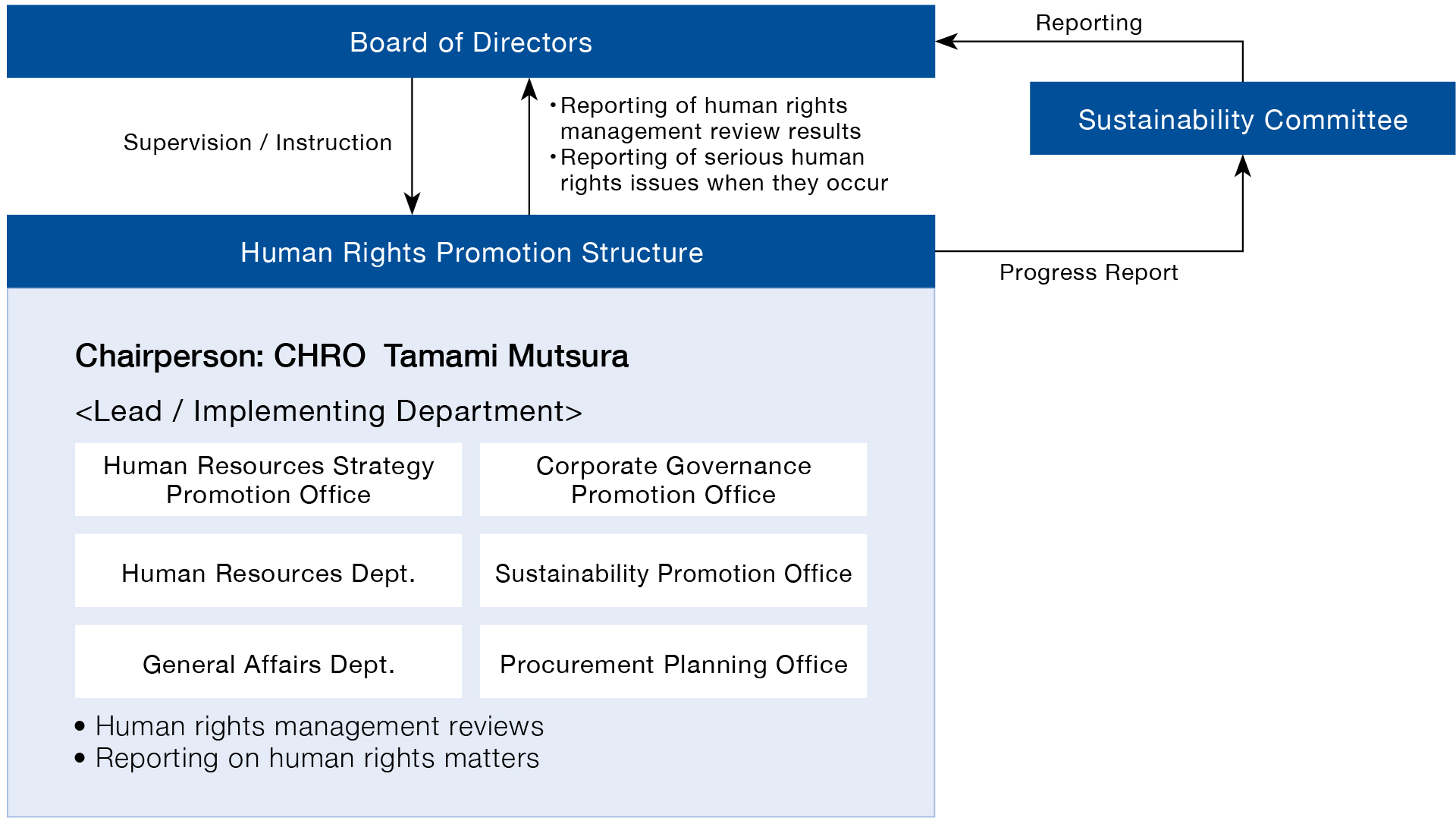
Departments in areas such as human resources, procurement, governance and sustainability coordinate on human rights initiatives under the corporate human rights officer (CHRO), who is the person with responsibility over human rights matters.
To ascertain and improve the effectiveness of initiatives, related departments provide status reports to the CHRO as required and a human rights management review is conducted yearly. Results of management reviews are reported directly to the Board of Directors by the CHRO.
Reports on the progress of initiatives are also submitted to the Sustainability Committee for discussion every quarter. Under this governance framework, we clarify the roles and responsibilities of each department and endeavor to enhance the effectiveness of human rights efforts throughout the value chain.
Human Rights Due Diligence
In keeping with the United Nations’ Guiding Principles on Business and Human Rights (UNGP), Alps Alpine has established, and continuously operates, a human rights due diligence framework for identifying and assessing the adverse impacts of business activities and the supply chain on human rights, and for preventing and mitigating those adverse impacts.
Overview of Human Rights Initiatives
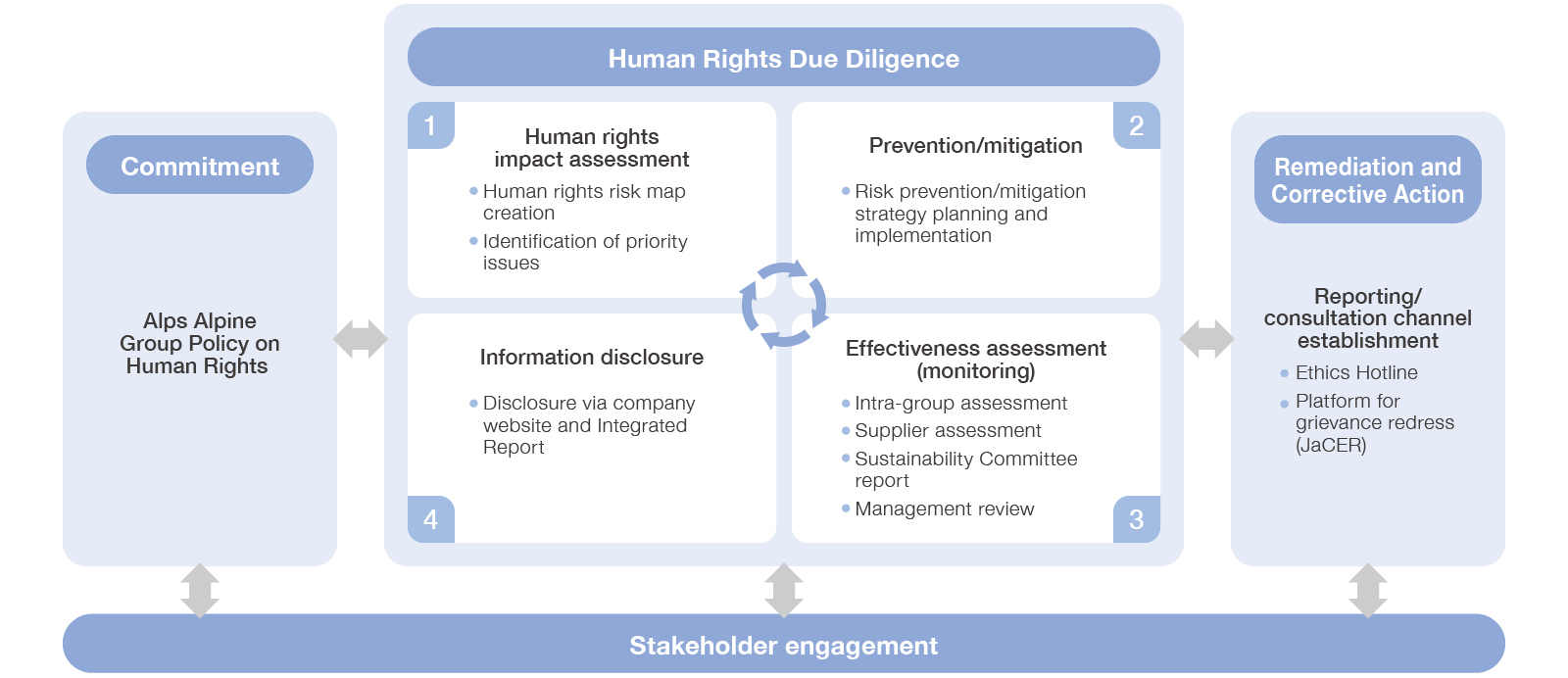
(1) Human Rights Impact Assessment / Risk Map Creation
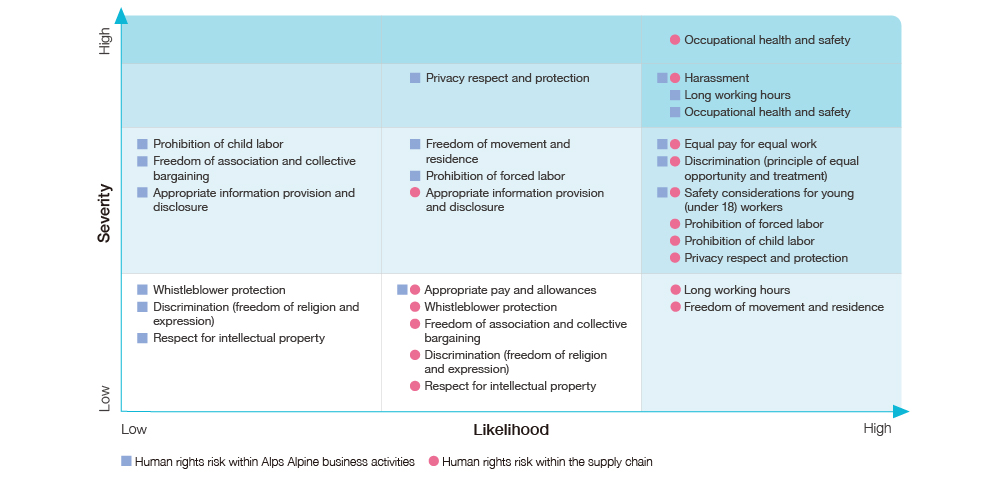
To specify adverse impacts on human rights, we identify and assess risks across the entire supply chain based on our own business environment and create a human rights risk map.
<Map Creation Process>
| Step 1 Identify risk factors |
We identified human rights risks related to Alps Alpine’s business domain in reference to the Universal Declaration of Human Rights and relevant international norms. |
|---|

| Step 2 Assess and map risks |
We assessed and mapped risks directly arising from Alps Alpine’s business activities and risks arising within the supply chain according to severity (scale, scope, irremediability) and likelihood. |
|---|
| Step 3 Specify priorities |
We determined an order of priority and specified four priority areas –occupational health and safety; harassment; long working hours; and respect for privacy and protection of personal information. |
|---|
To accommodate environmental changes, we will conduct regular reviews and continually update the human rights risk map through dialogue with internal parties, such as the compliance department and employee representatives, and outside experts.
<Human Rights Risk Map>
(2) Prevention and Mitigation
Alps Alpine endeavors to provide appropriate working conditions and environments for workers. We recognize this as an important issue not only for the Alps Alpine Group but also within the supply chain, and we act accordingly.
(3) Monitoring Status
Once every two years, we conduct monitoring within the Alps Alpine Group specific to human rights, including those related to workers’ rights and labor-management relations.
Human Rights Assessment Results
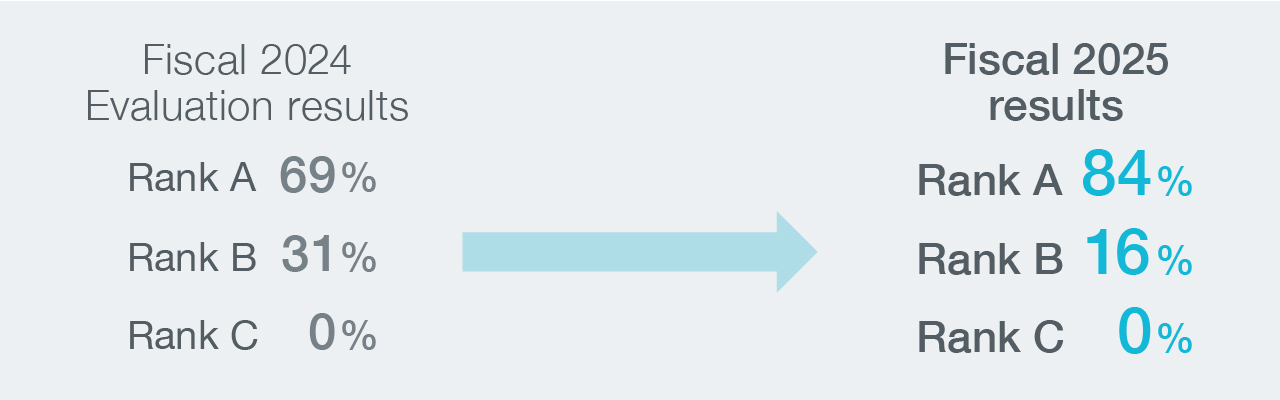
In fiscal 2025, we assessed 30 overseas affiliates to check the appropriateness of human rights-related processes and to ascertain the issues. As a result, 84% of overseas affiliates were given an A rank. Affiliates given a B rank were found to have inadequate provisions in terms of explicit inclusion in internal regulations and preparation of written procedures despite appropriate approaches being taken during day-to-day operations. Follow-up action and improvements are currently underway to ensure that adequate documentation and regulatory provisions are in place.
(4) Information Disclosure
We report on human rights efforts via our company website, Integrated Report and annual securities report, which are accessible by all stakeholders.
Efforts in Priority Areas
The Alps Alpine Group’s Human Rights Policy lists four priority areas identified through a human rights impact assessment – occupational health and safety; harassment; long working hours; and respect for privacy and protection of personal information. We pursue avoidance, prevention and mitigation efforts accordingly.
We have also established a framework for monitoring these risks and requesting corrective action as required not just within the Alps Alpine Group, but also in our relationships with suppliers.
Ensuring Occupational Health and Safety
As part of efforts to reduce the risk of a serious incident, such as a work-related accident, exposure to chemical substances, or fire, the Alps Alpine Group conducts an annual health and safety assessment of all bases in Japan. We also conduct ongoing health and safety education and awareness-raising activities with the aim of preventing workrelated accidents and improving safety awareness.
In addition, we endeavor to maintain and enhance employee mental and physical health, for example through the implementation of regular stress checks, enhancement of mental health measures, and advancement of health promotion measures. Through these initiatives, we are enabling workplace environments where employees can work safely and in good health.
Enforcing Harassment Prevention Measures
We strive to prevent harassment by communicating the importance of respecting human rights to employees of Alps Alpine and its Group companies. This is done through the establishment of company regulations prohibiting harassment and regular Alps Alpine Group Code of Conduct training.
We are also working to enhance consultation response capabilities through compliance training for newly appointed managers and to foster an open workplace culture supporting employee consultations. A framework is in place for preventing harassment and enabling quick remediation for victims and corrective action in the event a problem should occur.
Preventing Long Working Hours
We endeavor to prevent long working hours and achieve suitability of working styles through rigorous management of working hours and monitoring of actual work realities, as well as by encouraging annual paid leave utilization, raising awareness, and providing support for health management.
Employees’ perceived level of fatigue is also ascertained through regular stress checks, with guidance and support provided to ensure seamless access to an appropriate consultation service at the right time.
Privacy and Protection of Personal Information
We rigorously ensure compliance with company regulations relating to the protection of personal information and make ongoing efforts to raise awareness about, and enforce, proper information handling through regular information security management system (ISMS) training and Alps Alpine Group Code of Conduct training.
When employees’ personal information is to be used for business purposes, permission must be obtained through the prescribed application process. Use of the information must be kept to a bare minimum and this is strictly enforced.
Respect for Human Rights in the Supply Chain
Alps Alpine recognizes the importance of targeting the entire supply chain with efforts to promote respect for human rights and specifies this scope in the Alps Alpine Group’s Human Rights Policy.
Sharing of Conduct Guidelines with Business Partners
Alps Alpine has established the Alps Alpine Responsible Corporate Action Guidelines (guidelines for responsible business conduct) and we ask all business partners to understand and support the guidelines. We clearly communicate that the following items are especially important and must be complied with.
- <Key Items for Compliance/Implementation>
-
- Prohibition of child labor and forced labor
- Prohibition of discrimination
- Fair working conditions
- Ensuring health and safety
- Privacy and protection of personal information
Risk Assessments
For the human rights risk map we formulated in fiscal 2025, we identified risks arising within the supply chain in addition to risks directly arising from Alps Alpine’s business activities. Risks were assessed and mapped according to severity and likelihood.
CSR Assessments
We conduct CSR assessments to regularly check supplier compliance on human rights matters. If an assessment points to an issue with a supplier’s actions or approach, we request improvements as required and follow up with the supplier on an ongoing basis. We work alongside suppliers to minimize human rights risks.
For the latest on CSR assessments, visit:
Supplier Assessment Program
* For information on contacts for filing grievances relating to the supply chain, see “Remedial Action” below.
Remedial Action (Grievance Mechanism) Initiatives
Alps Alpine has established an internal reporting system for Group employees in Japan and overseas. Whistleblower confidentiality and prohibition of disadvantageous treatment of whistleblowers are strictly enforced. We have also established a consultation service to address grievances filed by a wide range of stakeholders, including parties in the supply chain. If it is revealed that human rights have been adversely impacted, we will go through the appropriate procedures to correct the situation and provide remedy.
Establishment of Internal Reporting Contacts (for Alps Alpine Group Employees)
We have established an Ethics Hotline independent of management to receive reports from employees of Alps Alpine and its Group companies in Japan. The hotline operates under strict conditions, with regulations clearly providing for whistleblower anonymity and prohibition of disadvantageous treatment of whistleblowers.
Similar contacts have been established at overseas affiliates, ensuring safe and secure access to consultation and reporting frameworks by employees of Alps Alpine and its Group companies anywhere in the world.
JaCER Grievance Mechanism (for Stakeholders)
To enable us to appropriately address human rights matters, including within the supply chain, we joined the Japan Center for Engagement and Remedy on Business and Human Rights (JaCER), a non-judicial grievance platform aligned with the UN Guiding Principles on Business and Human Rights, in April 2023. The platform allows reporting from anywhere in the world and is accessible to all stakeholders (and their representatives or support groups) of the Alps Alpine Group whose human rights are adversely impacted, or in danger of being adversely impacted, by Alps Alpine’s business activities. This may include employees of the Alps Alpine Group, our suppliers and those who work for them, and members of the local community. The mechanism complements existing internal reporting contacts, providing a framework for dialogue and corrective action via a fair and highly transparent process aided by an independent third party.

Human Rights Education
Every year, we implement Alps Alpine Group Code of Conduct training for employees worldwide (including contract employees, temporary employees and other non-regular employees) in order to promote and entrench the code, including aspects relating to respect for human rights. In fiscal 2025, globally around 27,000 employees received the training.
| Scope | FY2023 | FY2024 | FY2025 | |
|---|---|---|---|---|
| Participation rate for training on the GROUP CODE OF CONDUCT | Consolidated | 98.0% | 98.1% | 99.1% |
In Japan, the establishment of the Alps Alpine Group’s Human Rights Policy in fiscal 2025 presented an opportunity to enhance understanding about respect for human rights. Respect for human rights was therefore chosen as the theme for sustainability training provided to all Japan-based employees, including employees of Group companies (around 8,100 people).
Level-specific training, such as for new employees and newly appointed managers and officers, also incorporates human rights themes corresponding to the respective standpoints (e.g. instruction on consultations and initial action relating to harassment provided in new manager training). This is to instill a level of understanding that will be replicated in the workplace.
Metrics and Targets
| Scope | FY2023 Results |
FY2024 Results |
FY2025 Results |
Mid-Term Management Plan 2027 FY2027 Target |
||
|---|---|---|---|---|---|---|
| Number of serious human rights incidents | Consolidated | 0 cases | 0 cases | 0 cases | 0 cases |