Sustainability Management
Basic Policy
Alps Alpine treats environmental, social and governance (ESG) matters as a key management theme and aims for a sustainable society and corporate value enhancement over the medium to long term. At the heart of this stance lies our Corporate Philosophy and five-pronged Management Approach, laying out common values of the Alps Alpine Group, while the Alps Alpine Group Code of Conduct serves as a set of clear behavioral guidelines for implementation of those values by individual employees.
Key Elements of The Alps Alpine Group Code of Conduct
| Strive for Value |
|
Act with Integrity |
|
|---|---|---|---|
| Love the Planet |
|
||
| Contribute to Society |
|
||
| Respect the Individual |
|
* The Alps Alpine Group Code of Conduct upholds international norms such as the United Nations’ Guiding Principles on Business and Human Rights and OECD Guidelines for Multinational Enterprises on Responsible Business Conduct.

Integration and Promotion of Materiality-Based Management
For the Company’s Mid-Term Management Plan 2027, we redefined our materiality in light of changes in social conditions and the business environment. This was then reflected in the plans of individual headquarters and functions. The progress of activities undertaken in line with those plans is monitored by the Sustainability Committee and other subcommittees or meetings. Steps are taken to resolve any issues.
Promotion Structure
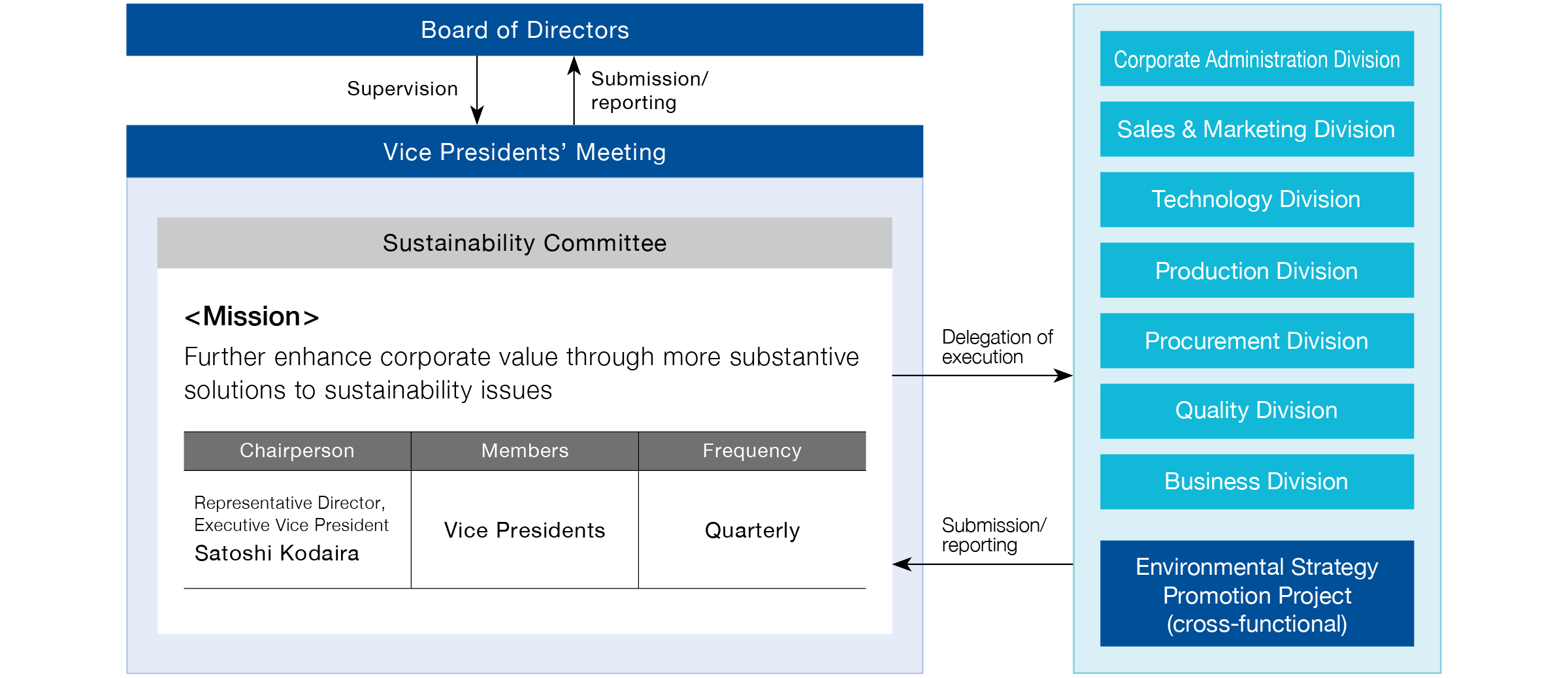
Alps Alpine positions the Sustainability Committee as part of the Vice Presidents’ Meeting, aiming for swifter, more substantive solutions to sustainability issues. The committee convenes quarterly to monitor the progress of activities within each headquarters and function and to discuss and guide responses to the various issues. Committee deliberations are reported to the Board of Directors, which oversees efforts involving senior management to improve activity effectiveness. To encourage executives to show leadership in addressing sustainability issues, indicators related to external ESG evaluations of the Company have been included in assessments for restricted stock compensation for executive officers since fiscal 2024.
In fiscal 2026, the Company launched the Environmental Strategy Promotion Project to advance activities under a cross-functional framework involving appointees from all functions, including production, engineering, quality management and sales. As no one function can tackle all environment-related issues alone, project participants share and evaluate targets and measures and promote activities from a companywide perspective.
Sustainability Topics on the Agenda at Fiscal 2025 Management Meetings
| Management meeting | Month | Agenda |
|---|---|---|
| Sustainability Committee | Apr. |
|
| Board of Directors | Apr. |
|
| Sustainability Committee | Jul. |
|
| Human Capital Meeting | Jul. |
|
| Board of Directors | Sep. |
|
| Sustainability Committee | Oct. |
|
| Human Capital Meeting Companywide HR Development Meeting |
Dec. |
|
| Board of Directors | Dec. |
|
| Sustainability Committee | Jan. |
|
| Board of Directors | Jan. |
|
| Board of Directors | Feb. |
|
| Vice Presidents’ Meeting | Feb. |
|
| Board of Directors | Mar. |
|
| Management Plan Meeting | Mar. |
|
Sustainability Training
Sustainability-related training has been provided to all employees in Japan, including officers and temporary employees, since fiscal 2022. In fiscal 2025, training covered the topics of Sustainable Procurement. Implemented as a video, there were around 8,100 participants. A questionnaire was also conducted to survey employees about sustainability matters, such as their sustainability awareness and topics they wished to learn about. Findings will be reflected in the training program for fiscal 2026.
< Past Training Themes >
| Fiscal year | Training theme |
|---|---|
| 2025 | Respect for human rights |
| 2024 | Sustainable procurement |
| 2023 | Decarbonization and circular economy realization |
| 2022 | SDGs and ESG |