Information Security
Basic Policy
As the digitalization of business continues, information security (cybersecurity) plays an increasingly critical role in risk management. The impact on Alps Alpine’s business operations is mounting. Alps Alpine identifies cybersecurity strengthening as a key materiality theme. This is based on the growing threat that ever more sophisticated cyberattacks pose to our business sphere, including plants and suppliers, as well as the increasing risks associated with changes in the business environment, such as the emergence of cloud computing and artificial intelligence. The Alps Alpine Group has put in place an Information Management Committee to establish ISO/IEC 27001-compliant regulations pertaining to information management, deploy information security enhancement measures, and implement employee training, while liaising with information officers in individual departments to promote safe and secure information management throughout our global operations.

Identified Information Security Risks
Changes in our internal and external environments are potentially conducive to the falsification, destruction or leaking of information, or information systems, possessed or used by the Company. Alps Alpine identifies the following information security risks.
- Suspension of operations or production/shipment activities
- Payment of damages for the leaking of entrusted information
- Deterioration of competitiveness due to the leaking of new technology
- Damage to corporate image and loss of sales opportunities caused by a security incident
- Tightening of regulations in each country
- Cyberattacks targeting new areas (supply chains, plant control systems, Alps Alpine cloud services, and work environments introduced with work style reform)
- Security risks associated with the use of artificial intelligence
Implementation Structure
Alps Alpine has established an Information Management Committee that endeavors to lower information security risks for the entire Alps Alpine Group and enable proper information management.
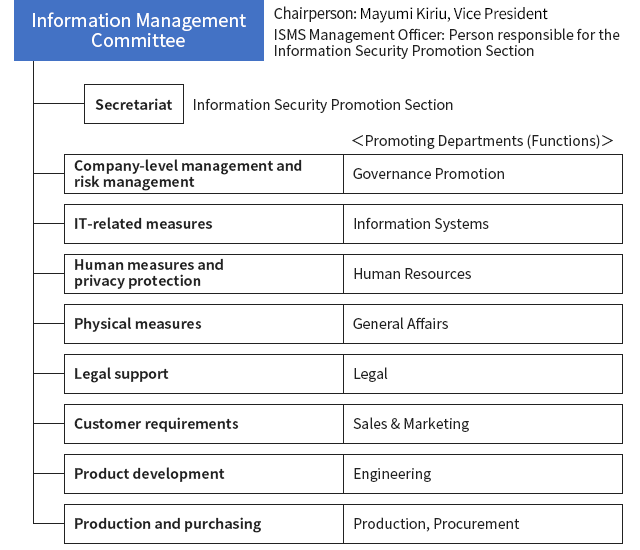
Implementation
Annual information management audits of each department are conducted to ascertain the level of entrenchment of information management policy and measures, and to promote ongoing improvements. The audits check the status of information management, implementation of education and current and future challenges based on past implementation, issues and environmental changes.
In response to changes in the business environment – primarily, the growing threat of fraud and other misconduct, as well as increasing use of cloud systems and the spread of alternative working styles, such as working from home – we are building a comprehensive risk management framework comprising a matrix of controls combining site management and control of critical information.
Information Security Strengthening
Alps Alpine is working to optimize information and security system operation, maintenance, and failure response through operational audits of related departments (including plants) and suppliers. This even encompasses production infrastructure under the category of factory automation/operational technology. By pursuing these efforts, we are putting in place frameworks for preventing data falsification and leaks and maintaining stable systems operation.
We have also set up a Computer Security Incident Response Team (CSIRT) to enable swift and appropriate action to minimize damage in the event of an information security incident. Cyberattack response drills and other incident response training are regularly held at bases worldwide to enhance the response capability. Company executives also take part.
For more about cybersecurity for automotive products, visit:
For more about privacy protection, visit:
Certification
Trusted Information Security Assessment Exchange (TISAX) certification, based on the German Association of the Automotive Industry Information Security Assessment (VDA-ISA), has been acquired for sales, development and production bases involved in the automotive business. Efforts to keep the certification up to date are ongoing.
Metrics and Targets
Mid-Term Management Plan 2027 metrics and targets and past performance are as follows.
| Scope | FY2025 Results |
Mid-Term Management Plan 2027 FY2027 Target |
||
|---|---|---|---|---|
| Implementation of secure information management and control systems for customers, products, and internal use | Consolidated | Sequential regional introduction underway | System introduced and operations started | |
| Management of research and information related to alliance companies | Consolidated | Start of discussions with alliance companies | Various related guidelines developed and implemented |