Corporate Governance
Basic Policy
We believe in the importance of maximizing the interests of all stakeholders, including shareholders, customers, local communities, and employees. Our basic policy is to achieve sustainable growth and maximize corporate value over the medium to long term, while balancing the interests of all stakeholders and returning profits to them, directly or indirectly.
In addition, to fulfill our responsibilities to stakeholders and realize effective corporate governance, we have established the Alps Alpine Co., Ltd., Corporate Governance Policies.

< The Alps Alpine Group’s Corporate Governance >
To consistently improve our corporate value, we have established and operate a system that facilitates appropriate and efficient decision-making and business execution, the timely reporting of results to stakeholders, and sound, efficient, and transparent management.
Corporate Governance Structure
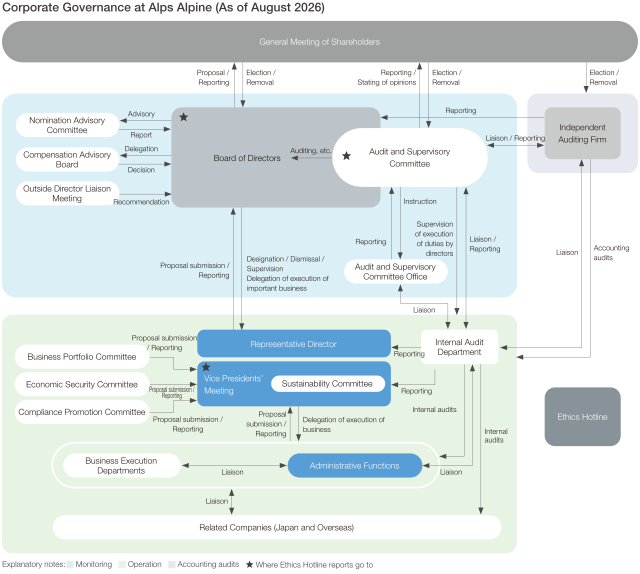
Alps Alpine has adopted a company structure with an audit and supervisory committee system as its organizational design, and the Audit and Supervisory Committee, which is independent from executive officers, audits and supervises the activities of the Board of Directors in close cooperation with accounting auditors and the internal audit department. In addition, the Nomination Advisory Committee and the Compensation Advisory Board, the majority of which consist of outside directors, have been established as advisory bodies to the Board of Directors. Through these measures, we will continue to enhance our corporate governance and realize fair, transparent, and highly effective management.
Corporate Governance at Alps Alpine
Board of Directors
We position the Board of Directors as an entity responsible for auditing and supervising business execution, striving to strengthen its monitoring functions. The Board of Directors deliberates and decides on key management matters, including basic management policies and the Mid-Term Management Plan, while ensuring opportunities for discussions aimed at medium- to long-term growth and enhancing corporate value.
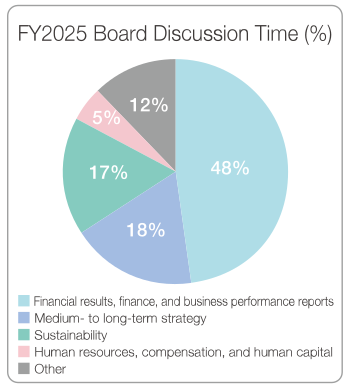
In FY2025, the Board of Directors actively discussed the progress of initiatives to achieve the Mid-Term Management Plan 2027, reviews of the business portfolio and material issues, and progress against the annual plan for sustainability activities. In FY2026, the Board of Directors plans to advance discussions on further corporate governance reforms based on the evaluation of the Board’s effectiveness, as well as business scenarios for realizing Vision 2035 and measures to achieve the Mid-Term Management Plan 2027.
Composition of Directors
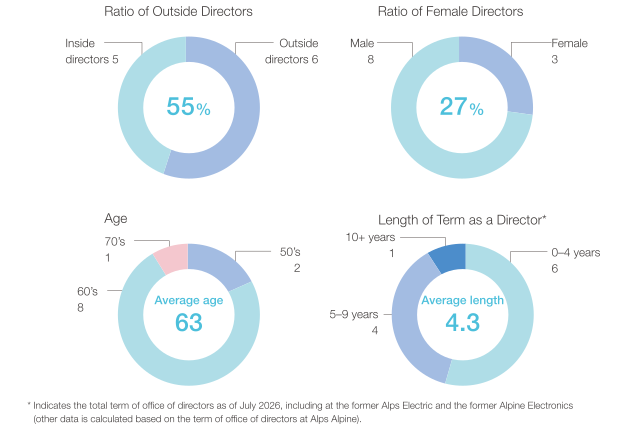
Skills Matrix, and Attendance of the Board of Director
| Position and Name | Knowledge and Expertise with Expected Demonstration of Particular Skills | Attendance at Board meetings in fiscal 2025 (rate) | ||||||||
|---|---|---|---|---|---|---|---|---|---|---|
| Corporate management | Technology / R&D | Manufacturing / Quality | Sales / Marketing | Financial accounting / Finance | Legal / Risk management | DX / IT | ESG / Sustainability | Global experience | ||
|
Hideo Izumi Representative Director, President (Chairman of the Board) |
● | ● | ● | ● | 12/12 (100%) |
|||||
|
Satoshi Kodaira Representative Director, Executive Vice President |
● | ● | ● | ● | ● | 12/12 (100%) |
||||
|
Yoshikatsu Watanabe Director, Senior Vice President |
● | ● | - | |||||||
|
Masami Aihara Director, Senior Vice President |
● | ● | ● | - | ||||||
|
Naofumi Fujie Director |
● | ● | 12/12 (100%) |
|||||||
|
Noriko Oki Director |
● | 12/12 (100%) |
||||||||
|
Hidefumi Date Director |
● | ● | ● | 12/12 (100%) |
||||||
|
Yasuo Sasao Director, Audit and Supervisory Committee Member |
● | ● | ● | ● | 12/12 (100%) |
|||||
|
Yuko Gomi Director, Audit and Supervisory Committee Member |
● | ● | 12/12 (100%) |
|||||||
|
Hiroshi Nomura Director, Audit and Supervisory Committee Member |
● | ● | ● | ● | - | |||||
|
Emi Machida Director, Audit and Supervisory Committee Member |
● | ● | ● | - | ||||||
Expected Knowledge and Expertise
| Corporate Management | Make accurate decisions considering the market environment surrounding the Company to achieve sustainable growth and enhance corporate value. |
|---|---|
| Technology and R&D | Maximize the use of our technologies to create values of excitement, safety, and the environment. |
| Manufacturing and Quality | Ensure manufacturing and quality assurance necessary to provide products and services that earn customer trust and satisfaction. |
| Sales and Marketing | Create business opportunities in a rapidly changing market environment, accelerate the Company’s growth, and advance strategies for enhancing corporate value. |
| Financial Accounting and Finance | Align with management strategies to build a balanced financial foundation focused on growth investments, sound finances, and shareholder returns, and implement strategies and measures. |
| Legal and Risk Management | Establish appropriate governance structures, and respond quickly and aptly from the perspectives of legal compliance, internal control, and risk management. |
| DX/IT | Leverage data and digital technology to transform and streamline business and operational processes. |
| ESG and Sustainability | Contribute to solving social issues through our business towards realizing a sustainable society. |
| Global Experience | Develop and execute businesses strategies from diverse values and global perspectives. |
Appointment of Outside Directors
Alps Alpine appoints outside directors based on their wealth of experience and extensive insight as experts on business management, law, and accounting from an objective perspective to offer advice on and conduct oversight of Company management.
The independence of outside directors is confirmed on the basis of Company standards for the selection of director candidates, upon which outside directors, with their consent, are designated as independent directors and their designation is submitted to the Tokyo Stock Exchange, Inc.
| Name | Reason for Appointment | Main Concurrently Held Positions |
|---|---|---|
| Naofumi Fujie | He has a wealth of knowledge in product development and management experience in the automotive industry. | |
| Noriko Oki | She is well versed in corporate analysis based on her many years of experience in the financial industry. | Outside Director, DISCO Corporation |
| Hidefumi Date | He possesses experience and knowledge in corporate planning, accounting, finance, and taxation, as well as experience in managing companies. | Outside Director, Sumitomo Mitsui Trust Bank, Ltd. (Audit and Supervisory Committee Member) (present) |
| Yuko Gomi | She has a wealth of specialist knowledge and experience as an attorney, and has accumulated a wide breadth of knowledge through her experience as a member of expert committees for government agencies. | Outside Corporate Auditor, NIPPON GAS CO., LTD. |
| Hiroshi Nomura | He has extensive corporate management experience and considerable expertise across a broad range of fields, including business strategy, management control, human resources, accounting, and finance. | |
| Emi Machida | She has many years of specialist knowledge and experience in finance and accounting as a certified public accountant, as well as broad insight. | Outside Audit & Supervisory Board Member, Yakult Honsha Co., Ltd. |
Outside Director Liaison Meetings
We hold Outside Director Liaison Meetings to share information with outside directors. Starting in FY2025, these meetings are held monthly and serve as a forum for exchanging views that transcend individual expertise, with themes appropriately set to enhance our corporate value.
Outside Directors Liaison Meeting Activities
| Date | Key Topics |
|---|---|
| June 2025 | Audit and Supervisory Committee: Report on on-site audit in China |
| July 2025 | Report on visits to domestic sites |
| August 2025 | Report on visits to domestic sites |
| September 2025 | Enhancing the effectiveness of the Board of Directors |
| October 2025 | Direction of the North American business |
| November 2025 | Approach to the cost of capital |
| December 2025 | FY2026 Risk Map |
| January 2026 | Approach to accounting treatment |
| February 2026 | Strengthening manufacturing capabilities |
| March 2026 | Strengthening governance functions |
| April 2026 | Results of the evaluation of the effectiveness of the Board of Directors |
Evaluation of the Effectiveness of the Board of Directors
Overview of FY2025 Evaluation Results
- <Purpose and Objective>
- We evaluate the effectiveness of the Board of Directors to achieve effective corporate governance by improving the Board’s effectiveness and further enhancing its functions.
- <Frequency>
- Once per year
- 1. Evaluation Process
-
- Reported the evaluation method and schedule for Board effectiveness at the February 2026 Board of Directors meeting
- In March 2026, conducted a signed Board effectiveness evaluation survey of all 11 directors
- Held an exchange of opinions on Board effectiveness at the April 2026 Management Committee Meeting
- Conducted a discussion on Board effectiveness at the April 2026 meeting with outside directors
- At the April 2026 Board of Directors meeting, discussed the opinions from items 3 and 4, and finalized the FY2025 evaluation
- 2. Survey Items
-
The main categories of the FY2025 survey are shown below. To enable continuous year-to-year measurement, certain questions in the Board effectiveness evaluation survey are carried over each year, while other items are revised annually to improve the quality of the evaluation. For FY2025, the same survey items as in FY2024 were used in order to assess progress on resolving issues related to previously low-rated areas.
Additionally, open-ended questions were included to allow for a wide range of opinions and suggestions beyond the set survey items.Survey items
- Board of Directors size and composition
- Board of Directors operations
- Topics discussed by the Board of Directors
- Communication among directors
- Support system for the Board of Directors
- Operation of the Nomination Advisory Committee and Compensation Advisory Board
- 3. FY2025 Initiatives to Improve Effectiveness
-
Based on the results of the Board effectiveness evaluation in FY2024, we addressed four priority issues in FY2025. Our FY2025 results and evaluation findings, together with our FY2026 policies and measures, are shown in the table below.
Priority Issues FY2025 FY2026 Results Evaluation Findings Policies Measures Securing and enriching time for discussion on key themes related to enhancing corporate value - Preparation of an annual agenda for corporate value enhancement themes and allocation of time based on their importance
- Review of the criteria for submitting matters to the Board of Directors to allocate more time to deliberations and discussions on key management issues (effective April 2026)
- Review of the frequency of Vice Presidents’ Meetings to support Board discussions and appropriate decision-making (effective April 2026)
- Advance scheduling of discussion time has proved effective
- Discussions on growth scenarios beyond the Mid-Term Management Plan 2027 need to be accelerated
- Non-financial areas, including compliance and risk management, also need to be strengthened
- Secure time to discuss growth scenarios and high-priority non-financial areas
- Develop an annual agenda focused on specific themes, including growth scenarios and compliance
Continued improvement in the preparation of materials for management meetings - Advance review of materials by administrative functions
- Training on preparing meeting materials
- Provision of a format specifying the information required for deliberation
- Preparation of summary papers and differentiation between core documents and appendices
- Advance reviews have fostered greater attention to the preparation of meeting materials
- Issues remain with the review process leading up to agenda submission and with excessive information obscuring the key points
- Improve the agenda submission process
- Clarify key discussion points through concise, clear materials
- Review processes, including the establishment of meeting structures in each division
- Ensure consistent use of summary papers and a clear distinction between core documents and appendices (continued from the previous fiscal year)
Providing further training opportunities for directors and vice presidents - Regular training for directors and vice presidents focused on ROIC management
- Individual training for vice presidents using external training providers
- Expertise in finance and governance needs to be strengthened
- Discussions on future sustainable growth need to be more substantive
- Select training topics for directors and vice presidents that address key management issues and contribute to sustainable growth
- Provide individual training for vice presidents (continued from the previous fiscal year)
Improving communication among officers - Meetings between outside directors and vice presidents
- Communication among directors remains strong
- Communication between outside directors and vice presidents needs to be further strengthened
- Increase the frequency and depth of communication between outside directors and vice presidents
- Meetings between outside directors and vice presidents (continued from the previous fiscal year)
- Participation by outside directors in Vice Presidents’ Meetings
- 4. Overview of FY2025 Board Effectiveness Evaluation Results
-
Taking into account the initiatives undertaken in FY2025 and the results of the FY2025 effectiveness evaluation survey, exchanges of views at the Management Committee and Outside Director Liaison Meetings, and discussions by the Board of Directors, we concluded that the Board’s effectiveness was appropriately maintained in FY2025.
Compared with the previous fiscal year, improvements were particularly evident in more open and vigorous discussions among directors, feedback to the Board on dialogue with institutional investors, and increased time for discussion on the Company’s direction and management strategy.
At the same time, there was broad agreement that continued improvement is needed in areas including further refinement of the material preparation process, improving the quality of discussions on key themes that contribute to enhancing corporate value, and strengthening the expertise of directors and vice presidents.
Based on these results, in FY2026, we will focus on the following priority themes to further enhance the effectiveness of the Board of Directors.
- Continued improvement of material preparation and deliberation processes for Management Meetings
- Securing and enriching time for discussions on key themes related to enhancing corporate value
- Expanded training opportunities for directors and vice presidents that address management issues and support sustainable growth
- Further enhancement of information sharing and dialogue between outside directors and vice presidents
The Board of Directors will continue using effectiveness evaluations as part of its PDCA cycle, further strengthen its oversight of management, and work to achieve sustainable enhancement of corporate value.
Vice Presidents’ Meeting
We have introduced a vice president system to separate management oversight from business execution, aiming to expedite decision-making in business operations. Directors entrusted with key business executions by the Board of Directors guide and supervise the vice presidents responsible, significantly delegating executive authority to them in their respective business areas, thereby establishing a system for swift and accurate decision-making.
In addition, under the authority delegated by the vice presidents, executive managers have been positioned to carry out efficient and timely execution within designated operational areas.
Audit and Supervisory Committee
The Company’s Audit and Supervisory Committee consists of four members, two men and two women. It comprises outside Audit and Supervisory Committee members with extensive experience as lawyers, certified public accountants, and business managers, and inside Audit and Supervisory Committee members who are familiar with our business. The committee is chaired by an outside Audit and Supervisory Committee member to ensure that, as an independent organization, the transparency of our business activities and the effectiveness of our governance remains at a high level. Through attendance at important meetings, review of important documents, and interviews with the representative directors, other directors, vice presidents, and employees, the Audit and Supervisory Committee members audit the execution of duties by directors from an objective standpoint, independent of that of the Board of Directors. Through close cooperation with the internal audit department and accounting auditors, the Audit and Supervisory Committee endeavors to share its views at the Board of Directors’ meetings and other important meetings.
The Company has selected a full-time Audit and Supervisory Committee member to strengthen the monitoring function of the Audit and Supervisory Committee by exchanging information with directors and employees daily and by attending essential meetings to obtain information necessary for their activities as an Audit and Supervisory Committee member. The full-time Audit and Supervisory Committee member shares this information with other Audit and Supervisory Committee members and exchanges opinions at Audit and Supervisory Committee meetings, focusing on priority audit items to form audit opinions. Outside Audit and Supervisory Committee members also serve on the Nomination Advisory Committee and Compensation Advisory Board, where they participate in discussions and provide advice.
In addition, full-time staff with appropriate knowledge, ability, and work experience are assigned to assist with the duties of the Audit and Supervisory Committee, and independence from directors (excluding board members that are Audit and Supervisory Committee members) is secured for the employees in charge of such duties.
Composition and Attendance of the Audit and Supervisory Committee
| Position and Name | Attendance in FY2025 |
|---|---|
|
Director, Audit and Supervisory Committee Member Yuko Gomi (Chairman of this committee) |
13/13 (100%) |
|
Director, Audit and Supervisory Committee Member Yasuo Sasao |
13/13 (100%) |
|
Director, Audit and Supervisory Committee Member Hiroshi Nomura |
- |
|
Director, Audit and Supervisory Committee Member Emi Machida |
- |
* Kazuya Nakaya and Yoko Toyoshi, who were members of the Audit and Supervisory Committee in FY2025, attended all 13 Committee meetings (100%).
Evaluation of the Effectiveness of the Audit and Supervisory Committee
Overview of Audit and Supervisory Committee Effectiveness Evaluation
The Audit and Supervisory Committee conducts an annual effectiveness evaluation to enhance its effectiveness by reviewing its activities for the year under review and reflecting the findings in the audit policy and plan for the following fiscal year. By assessing and analyzing whether it is functioning appropriately in monitoring and supervising the Board of Directors’ execution of duties, the Committee also establishes a basis for the effectiveness evaluation. Furthermore, integrating the two evaluations and related discussions clarifies the measures needed to achieve the Company’s governance improvement goals and helps inform future management.
As part of the evaluation, all four Audit and Supervisory Committee members conducted self-evaluations incorporating their individual observations regarding the Committee’s composition and operations, audit activities, accounting audits, and coordination among the three audit functions. In FY2025, to gain a more objective view of the Committee’s effectiveness, the evaluation also incorporated assessments and opinions from directors who are not Committee members, in addition to the self-evaluations traditionally conducted by its members.
The evaluation confirmed that the Committee’s basic structure and audit functions were generally operating appropriately. At the same time, it was recognized that further consideration is needed to strengthen the approach to risk-based audit policies and plans, the overall roles of and coordination among the three audit functions, and visibility into governance across the Group. The evaluation results and the policy for future initiatives have been reported and shared with the Board of Directors. We will continue working in coordination with the Board to enhance the effectiveness of the Audit and Supervisory Committee and the Company’s corporate governance.
Internal Audits
Alps Alpine’s internal audit department undertakes activities with the aim of contributing to the attainment of management targets by evaluating the effectiveness of the company’s governance, risk management, and compliance processes.
The internal audit department implements internal audits of the company and its subsidiaries in accordance with internal audit plans approved by the Board of Directors. The internal audits are performed to check that business affairs are conducted properly and lawfully from the standpoints of reliability of information about financial and operational matters; attainment of business targets; protection of assets; and conformance with laws, policies, established procedures, and agreements. Suitable advice on making improvements is then provided. Results of internal audits and areas identified for improvement are reported to the Board of Directors and the Audit and Supervisory Committee.
Under a three-way audit system, the internal audit department cooperates and liaises with both the Audit and Supervisory Committee and the company’s accounting auditor to ensure an efficient auditing process.
Nomination Advisory Committee and Compensation Advisory Board
The Nomination Advisory Committee and the Compensation Advisory Board have been established as advisory bodies to the Board of Directors to enhance objectivity and transparency regarding matters related to the nomination and dismissal of directors, the selection and dismissal of vice presidents, and the compensation of directors (excluding those who are Audit and Supervisory Committee Members) and vice presidents, as well as to improve corporate governance. Both committees are chaired by outside directors, and outside directors comprise the majority of each committee. To ensure coordination between the two committees, outside directors and others who have not been appointed as committee members also participate as observers, creating a highly effective deliberation framework.
Composition and Attendance of each committee
| Nomination Advisory Committee | |
|---|---|
| Position and Name | Attendance in FY2025 |
|
Director Naofumi Fujie (Chairman of this committee) |
6/6 (100%) |
|
Representative Director, President Hideo Izumi |
6/6 (100%) |
|
Representative Director, Executive Vice President Satoshi Kodaira |
6/6 (100%) |
|
Director Noriko Oki |
6/6 (100%) |
|
Director Hidefumi Date |
- |
|
Director, Audit and Supervisory Committee Member Yuko Gomi |
- |
|
Director, Audit and Supervisory Committee Member Hiroshi Nomura |
- |
| Compensation Advisory Board | |
|---|---|
| Position and Name | Attendance in FY2025 |
|
Director Hidefumi Date (Chairman of this committee) |
6/6 (100%) |
|
Representative Director, President Hideo Izumi |
6/6 (100%) |
|
Representative Director, Executive Vice President Satoshi Kodaira |
6/6 (100%) |
|
Director Noriko Oki |
- |
|
Director, Audit and Supervisory Committee Member Hiroshi Nomura |
- |
|
Director, Audit and Supervisory Committee Member Emi Machida |
- |
* Kazuya Nakaya and Yoko Toyoshi, who were members of the Nomination Advisory Committee in FY2025, attended all six Committee meetings (100%).
* Kazuya Nakaya and Yoko Toyoshi, who were members of the Compensation Advisory Board in FY2025, attended all six meetings (100%).
Considerations by the Nomination Advisory Committee and Compensation Advisory Board
| Classification | Details of the Consideration |
|---|---|
| Nomination Advisory Committee |
|
| Compensation Advisory Board |
|
Sustainability Committee
As the body responsible for managing sustainability activities, we have established the Sustainability Committee, which comprises all vice presidents (Chair: Satoshi Kodaira, Executive Vice President and COO). Sustainability issues are incorporated into the Mid-Term Management Plan and short-term management plans, and are addressed by each division. The Committee meets quarterly to monitor and evaluate the progress of initiatives and to deliberate on individual measures. It also reports regularly to the Board of Directors four times a year.
Business Portfolio Committee
To pursue the sustained improvement in returns on capital that ROIC-based management is intended to achieve, we established the Business Portfolio Committee (Chair: Satoshi Kodaira, Executive Vice President and CFO), which began operations in August 2026. The committee deliberates policies on business selection and concentration and the allocation of management resources to growth areas, promoting business portfolio optimization from a Companywide perspective, including business restructuring and exits. The committee meets quarterly, with its deliberations submitted to and reported at the Vice Presidents’ Meeting.
Compliance Promotion Committee
As the body responsible for promoting compliance activities, we have established the Compliance Promotion Committee (Chair: Satoshi Kodaira, Executive Vice President and COO). The Committee works to establish and operate a Companywide compliance promotion framework, foster compliance awareness by promoting education and awareness-raising, and encourage adherence to rules and processes by conducting effective periodic inspections and sharing incident information and recurrence prevention measures across the organization. The Committee meets quarterly and submits matters for deliberation and reports to the Vice Presidents’ Meeting.
Economic Security Committee
Against a backdrop of increasingly complex international affairs and growing uncertainty in the business environment, we have established the Economic Security Committee (Chair: Mayumi Kiriu, Vice President) to minimize the impact on the Group of mounting economic security and geopolitical risks.
The Committee considers and implements any necessary responses based on information it gathers about economic security. The Committee meets quarterly and submits matters for deliberation and reports to the Vice Presidents’ Meeting as necessary.
Director Nomination and Compensation
The Nomination Advisory Committee and the Compensation Advisory Board were established as advisory bodies to the Board of Directors to enhance objectivity and transparency regarding matters related to the nomination and dismissal of directors, the selection and dismissal of other officers, and the compensation of directors (excluding those who are Audit and Supervisory Committee members) and other officers, as well as to improve corporate governance. The chairpersons of both committees are selected from the outside directors, and outside directors comprise the majority of each committee.
Nomination Policies
The Company has established criteria for the selection of directors and executive officers to ensure that those with sufficient ability and qualifications are appointed as directors. The Company’s policy is to nominate and appoint as candidates for directors and members of senior management those who possess exceptional management decision-making capabilities, foresight, and links, as well as a law-abiding spirit and high ethical standards.
Policy for Determining Remuneration
To ensure objectivity and transparency in officer remuneration, the Board of Directors has established the policy for determining remuneration and related matters, following deliberation by the Compensation Advisory Board.
We regard officer remuneration as a key element of the management foundation supporting the realization of Vision 2035, “Shaping a Future Where Technology Extends Your Senses,” and the Mid-Term Management Plan 2027. Our basic policy is for the officer remuneration system to serve as an incentive not only to achieve short-term performance targets, but also to enhance corporate value over the medium to long term, improve capital efficiency, and promote value sharing with shareholders. Specifically, we design the remuneration structure based on the following principles.
- Emphasize linkage with short-, medium-, and long-term performance
- Encourage officers to take action to sustainably improve earning power, capital efficiency, and shareholder value
- Provide sound incentives that curb excessive short-termism and contribute to sustainable enhancement of corporate value across the Group
The same remuneration structure applies to vice presidents who do not concurrently serve as directors, in line with this policy.
Process for Determining Directors’ Remuneration, etc.
Officer remuneration is determined within the total amount approved by the General Meeting of Shareholders.
To enhance objectivity and transparency, the Board of Directors delegates full authority to determine the remuneration of directors (excluding directors who are Audit and Supervisory Committee members) to the Compensation Advisory Board. Under this delegation, the Compensation Advisory Board deliberates on and determines the details of the remuneration system and the remuneration of each individual.
The remuneration of directors who are Audit and Supervisory Committee members is determined by the Audit and Supervisory Committee within the limits approved by the General Meeting of Shareholders.
Types of Remuneration
The remuneration of the Company’s executive directors comprises (a) basic remuneration, (b) bonuses, and (c) restricted share compensation. In principle, the composition is designed so that the proportion of variable remuneration reflects each director’s position.
Remuneration for outside directors and directors who are Audit and Supervisory Committee members consists solely of basic remuneration, reflecting their role in overseeing management. In both cases, they are paid a fixed remuneration on a monthly basis.
1) Policy on Basic Remuneration (Monthly remuneration)
Basic remuneration is paid monthly in the form of fixed remuneration in accordance with the officer’s position, etc.
2) Policy on Short-term Performance-Linked Remuneration (Bonus)
(1) Bonuses emphasize linkage with the achievement of annual management targets and are determined according to Companywide performance and individual evaluations for the fiscal year under review. Each bonus is calculated by applying Companywide performance (50% weighting) and the individual evaluation (50% weighting) to the standard payment amount established for each position. The payout rate for Companywide performance ranges from 0% to 300%, while that for the individual evaluation ranges from 0% to 200%. These are multipliers for the respective evaluations, and the final bonus amount is determined by taking their weighted average according to the applicable weightings.
The Companywide performance component is based on the performance of the reportable segments (Component Segment, Sensor and Communication Segment, and Mobility Segment) and is intended to support achievement of the Mid-Term Management Plan 2027. Its performance measures are three key indicators under the Plan: operating income margin, profit (loss) attributable to owners of parent, and ROE. Each performance measure is evaluated on a four-level scale according to the achievement rate against the target set in line with the Mid-Term Management Plan 2027, and the payout rate is determined from the total score after applying the weighting assigned to each measure. If either the operating income margin or profit (loss) attributable to owners of parent is negative, the payout rate for Companywide performance is set at 0%.
(2) Individual evaluations are designed to provide individualized incentives, with the payout rate determined on a five-level scale based on individual performance and management contribution, each assessed separately. Individual performance is assessed based on medium- to long-term initiatives and performance by business segment, among other factors, that cannot be captured by Companywide performance alone. To further strengthen the management execution framework, we also revised the assessment of management contribution, which had been weighted too heavily toward short-term and financial indicators, by increasing the weight of non-financial indicators such as human capital, sustainability, and governance, and by adding perspectives such as expectations, missions, and role behaviors, with the final assessment determined after peer evaluations by inside directors (excluding directors who are Audit and Supervisory Committee members) and vice presidents.
Remuneration Composition
| Performance Indicator | Weight | Range | Calculation Method | ||
|---|---|---|---|---|---|
| Companywide Performance | Current-term operating income margin | 50 | 25 | 0–300% | The achievement rate for each performance indicator is scored on a four-level scale against targets set in line with the Mid-Term Management Plan, and the payout rate is determined from the total weighted score. |
| Profit attributable to owners of parent | 15 | ||||
| ROE | 10 | ||||
| Individual Evaluation | Individual performance | 50 | 25 | 0–200% | The evaluations of individual performance and management contribution are combined using their respective weights and rates on a five-level scale. |
(Note) The final bonus amount is calculated as the weighted average of the payout rates for Companywide performance (50% weighting) and the individual evaluation (50% weighting).
3) Policy on Medium- to long-term performance-linked remuneration (restricted shares)
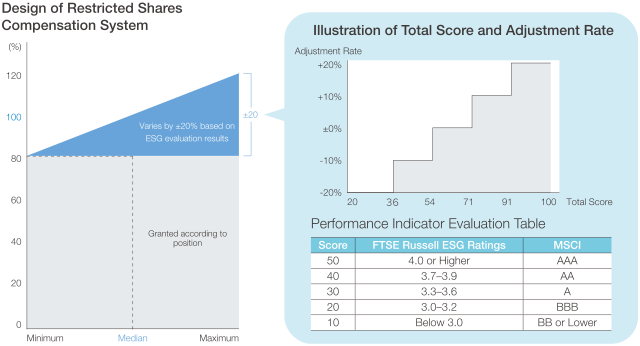
Restricted share compensation is calculated based on a standard amount established for each position, with the aim of promoting alignment of interests with shareholders and achieving sustainable enhancement of corporate value. A specified portion (20%) of this standard amount is adjusted in stages according to the performance indicator evaluation results, and the total compensation amount is designed to range from 80% to 120% of the standard amount.
We use ESG evaluation scores as the performance indicators because they enable objective assessment of our initiatives to address material issues and encourage improvement in company performance and corporate value over the medium to long term. Specifically, the three-year average scores from FTSE Russell ESG Ratings and MSCI, two leading third-party rating agencies, are each converted into points using five predefined bands, after which the scores for both indicators are totaled, and the prescribed coefficient corresponding to the resulting score range is applied to calculate the compensation amount.
Design of Restricted Shares Compensation System
| Restricted Share Compensation Details | Performance-Linkage Details | |||||
|---|---|---|---|---|---|---|
| Restriction Period | Allocation Method | Performance Indicator | Weight | Range | Calculation Method | |
| 40 Years (Effectively until leaving office) |
The number of restricted shares allocated is calculated using the closing price of the Company’s shares on the business day preceding the date of the Board of Directors resolution on their issuance or disposal and an amount determined by the Board of Directors within a range that is not favorable to the eligible officers. | ESG evaluation | FTSE Russell ESG Ratings |
50 | ±20% | Evaluated on a five-level scale using the three-year average scores |
| MSCI | 50 | |||||
Director Remuneration System
| Type of Remuneration | Eligible Recipients | |||
|---|---|---|---|---|
| Inside | Outside | |||
| Directors excluding Audit and Supervisory Committee Members | Audit and Supervisory Committee Members | |||
| Fixed remuneration | Monthly remuneration | ● | ● | ● |
| Performance-linked remuneration | Short-term performance-linked remuneration (bonus) | ● | ||
| Medium- to long-term performance-linked remuneration (restricted shares*) | ● | |||
* The number of restricted shares allocated is calculated using the closing price of the Company’s shares on the business day preceding the date of the Board of Directors resolution and an amount determined by the Board of Directors so as not to favor the eligible officers.
Remuneration Composition
| Classification | Basic Remuneration | Bonus | Restricted Share Compensation |
|---|---|---|---|
| (Fixed Monetary Remuneration) | (Variable Monetary Remuneration) | (Variable Non-Monetary Remuneration) | |
| President | 52% | 29% | 19% |
FY2025 Director Remuneration
(Millions of JPY)
| Classification | Number of Applicable Officers | Total Value of Remuneration | Total Remuneration by Type | |||
|---|---|---|---|---|---|---|
| Fixed Remuneration | Performance-Linked Bonuses | Restricted Shares Compensation | ||||
| Directors | Excluding Audit and Supervisory Committee members | 4 | 263 | 147 | 71 | 44 |
| Audit and Supervisory Committee members | 1 | 26 | 26 | — | — | |
| Outside directors | 6 | 86 | 86 | — | — | |
| Total | 11 | 375 | 259 | 71 | 44 | |
Clawback Provision
Alps Alpine has in place a clawback provision that enables the company, through deliberation by the Compensation Advisory Board and approval by the Board of Directors, to request the full or partial return of compensation paid to executive directors or executive officers as bonuses or restricted stock units in the case of serious law violations or other misconduct. In the case of a downward revision of the company’s financial results after bonuses have been already paid, the company will reassess the bonus rate, given that financial results are used to calculate bonuses, and request the return of all or some of the paid bonuses.
Internal Control Systems
Basic Policy on Internal Control Systems and Their Establishment
In keeping with the Companies Act and Regulations for Enforcement of the Companies Act, Alps Alpine has established systems for ensuring the appropriateness of business operations. This is the company’s basic policy on the establishment of internal control systems. Through the enhancement of internal controls aligned with those systems, Alps Alpine pursues sound management and business operations.
Our Path toward Stronger Corporate Governance
| Key Corporate Developments | Composition of Directors | Key Governance Initiatives | Compensation System | Nomination and Compensation Committees | |
|---|---|---|---|---|---|
| Fiscal 2013 |
|
||||
| Fiscal 2014 |
|
||||
| Fiscal 2015 | |||||
| Fiscal 2016 |
|
|
|
||
| Fiscal 2017 |
|
|
|||
| Fiscal 2018 |
|
|
|
|
|
| Fiscal 2019 |
|
|
|||
| Fiscal 2020 |
|
||||
| Fiscal 2021 |
|
||||
| Fiscal 2022 |
|
||||
| Fiscal 2023 |
|
|
|||
| Fiscal 2024 | |||||
| Fiscal 2025 |
|
|
|
||
| Fiscal 2026 |
Metrics and Targets
Mid-Term Management Plan 2027 metrics and targets and past performance are as follows.
| Scope | FY2025 Results |
Mid-Term Management Plan 2027 FY2027 Target |
||
|---|---|---|---|---|
| Board of Directors effectiveness evaluation score | Consolidated | Same score YoY | Improvement compared with previous year | |
| Development of internal regulations and rule frameworks | Consolidated | Formulation of regulations development plan | Development complete |