Gender Pay Report 2025
Alps Electric (Ireland) Limited continues to work towards improvements across our industry as part of the Government’s Gender Pay Gap reporting requirements.
We are committed to being an inclusive organisation where every employee can reach their full potential. We focus on creating an open and supportive workplace and on attracting, developing, and progressing the careers of all employees.
What is the gender pay gap?
The gender pay gap is the difference in the average earnings of men and women across an organisation, regardless of the roles they hold. This is different from equal pay, which refers to paying men and women the same amount for the same or equivalent work. We are confident that men and women are paid equally for doing the same, similar, or equivalent roles across our company. This report outlines our 2025 gender pay gap results.
Company Profile
Alps Electric EMS is a leading EMS provider based in Co. Cork, Ireland, delivering end-to-end electronics manufacturing from design and prototyping to full-scale production, supply chain management, and aftermarket support. Driven by strong ESG values, we prioritise sustainability, team collaboration, and community impact, co-creating smarter, greener, more resilient products with our partners.
Alps Electric supports 2 payroll types, weekly paid mainly comprises employees involved in production operations and support staff directly related to the production area and a monthly payroll which consists of management, supervisory, engineering, and support administration employees.
The gender pay gap figures include all employees and management on both weekly and monthly payrolls.
Analysis

Male Employees

Female Employees
| Male Employees | 180 |
|---|---|
| Female Employees | 200 |
| Total Employees | 380 |
As at June 5th 2025
Our organisation reflects a modern and inclusive automotive industry where gender balance is not only encouraged but achieved. With an almost equal representation of men and women across roles from engineering and manufacturing to leadership and technical support, we foster a workplace where diverse perspectives drive innovation. This balanced workforce strengths collaboration, enhances problem solving, and showcases our commitment to equal opportunity.
Pay
| Male Mean Hourly Rate | 26.888 |
|---|---|
| Female Mean Hourly Rate | 19.752 |
| Mean Gender Pay Gap | 26.54% |
| Male Median Hourly Rate | 19.755 |
|---|---|
| Female Median Hourly Rate | 16.585 |
| Median Gender Pay Gap | 16.05% |
Our gender pay analysis shows a mean hourly pay gap of 26.54%, indicating that when averaging all pay across the workforce, men earn more than women by 7.1%. This reflects the distribution of roles within the organisation, where a higher proportion of men occupy senior or higher-paid positions.
The median gender pay gap of 6.18% provides a more representative comparison of typical earnings. This smaller gap suggests that when comparing the midpoint of male and female earnings, pay is considerably more balanced. The difference between the mean and median gaps highlights that the higher paid roles have a significant influence on the overall average, while pay levels for most employees remain relatively close.
Pay Quartiles
The proportion of male and female employees according to quartile pay bands.
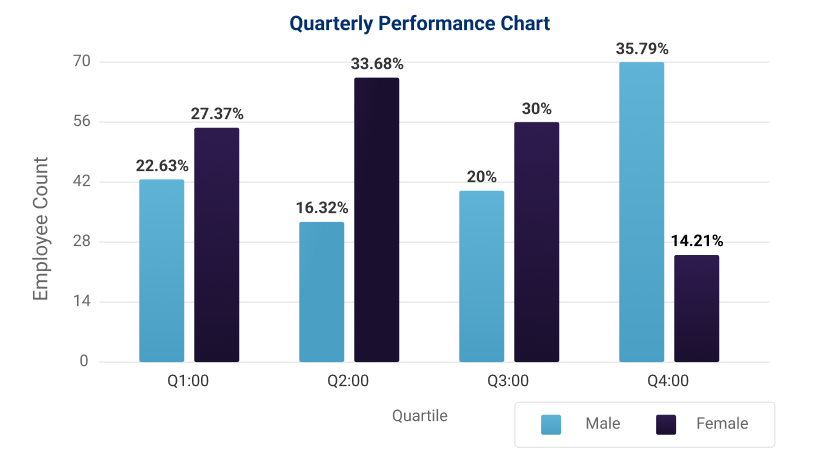
Lower Quartile 1: Gender representation is relativey balanced, with Males 22.63% and females 27.37%. This indicates a broadly even distribution in the lowest pay band.
Lower Middle Quartile 2: Women represent 33.68% while Males represent 16.32%. There is greater female representation in this band eg Administration.
Upper Middle Quartile 3: The gap here is narrower with a reduction in females and an increase in males.
Upper Quartile 4: In the highest pay quartile, Males make up 35.79% compare to women at 14.21%. This shows that men are more strongly represented in the top earning group eg Management & Engineering.
Our Strategy
Our employees are a key factor to our success. We are fortunate to have a highly capable and committed workforce, many of whom remain with us for several years and contribute enthusiastically to the goals of the organisation and the wider community.
Our HR teams continues to prioritise recruitment as a key focus area, particularly in relation to improving the gender balance of our intake. We maintain a strong commitment to flexible working, which supports employees who need to balance work and home life. We ensure succession planning processes conside gender representation.
Our Recruitment Strategy
We are committed to ensuring that our recruitment processes attract a diverse range of candidates. We will continue to recruit through multiple channels to reach a wide pool of potential applications, and we will monitor our processes to ensure both CV’s and candidates put forward reflect diversity in its broadest sense.