Product Quality & Safety
Quality
Basic Policy
The Alps Alpine Group has established the Quality Policy as its basic approach to quality, based on the GROUP CODE OF CONDUCT. To improve customer trust, we are engaged in Companywide quality maintenance and improvement activities that include not only production quality but also quality assurance of designs and parts, which are the origin of manufacturing and customer service.
Quality Policy
Under fair Quality Assurance activities, master ”Monozukuri Quality” to improve customer’s trust.
High-Quality Products and Services
Alps Alpine has included a statement on quality in the Alps Alpine GROUP CODE OF CONDUCT, saying we will endeavor to enhance the quality of products and services to maximize customer satisfaction. Both in Japan and overseas, quality problems have the potential to develop into major business risks. We will swiftly respond to incidents involving a product or service to limit the damage caused and we will investigate any incident to determine the facts, identify the causes and prevent a recurrence.
Alps Alpine GROUP CODE OF CONDUCT (excerpt)
| 1. | Strive for Value We will go all out to create new value | |
|---|---|---|
| We will keep putting forward highly appealing and richly unique products and services of benefit to humans, society and the planet; and we will act in good faith, placing top priority on quality and safety. | ||
| 1-1. New Value Creation | Possessing flexibility of mind without fear of failure, we will continually endeavor to break new ground with technologies and services and become better at our jobs. | |
| 1-2. Safety Assurance and Customer Protection | We will comply with safety-related laws, regulations, standards and in-house procedures in all processes, including product and service development, manufacturing, transportation, sales and maintenance; and we will endeavor to develop technology for improving safety, quality and usability, and engage in the supply of products and services that function safely and users feel safe to use. | |
| 1-3. High-Quality Products and Services | We will endeavor to enhance the quality of products and services to maximize customer satisfaction. | |
| 1-4. Accurate and Relevant Information on Products and Services | We will provide customers accurate information they require to happily and safely use our products and services. | |
| 1-5. Good Faith in Inquiries and After-Sales Service | We will respond to customer requests and inquiries in good faith; and we will provide suitable mechanisms, such as returns, repairs and maintenance, to assist customers in the event of a problem with a product or service sold. | |
| 1-6. Fast and Appropriate Response to Incidents | We will swiftly respond to incidents involving a product or service to limit the damage caused; and we will investigate any incident to determine the facts, identify the causes and prevent a recurrence, and disclose or report information internally and externally as required. | |
Quality Management System (QMS)
International standards for quality management systems are essential for business as they demonstrate that all departments are contributing to higher levels of customer satisfaction through quality assurance.
Production plants of Alps Alpine, including plants outside Japan, have acquired ISO 9001 certification. Plants producing products for the automotive industry have also acquired and maintain IATF 16949 certification.
Promotion of Prevention of Incidents by Taking the Proper Steps from the Start of Processes
To deliver products that satisfy our customers, we aim to take the proper steps from the start of processes. Through this, we are developing quality assurance (front-loading) activities from the planning stage of new products, including development, design, and production processes. Specifically, we have established an organization and system for front-loading activities in the Quality Assurance Department to review each process from a quality perspective, flatten down the issues, and promote countermeasures to prevent incidents from occurring.
Improve Degree of Completion of Product and Process Designs
To improve product design and process design perfection, all quality requirements are presented at the beginning of new product development to clarify and systematically verify how to guarantee no gaps or inconsistencies in the design stage. Issues detected through customer evaluations and verification in each process are considered essential for improvement and are fed back to front-loading activities.
Our suppliers, who supply us with the parts necessary for our products, also cooperate with our efforts to improve quality.
Global Quality Information Management System
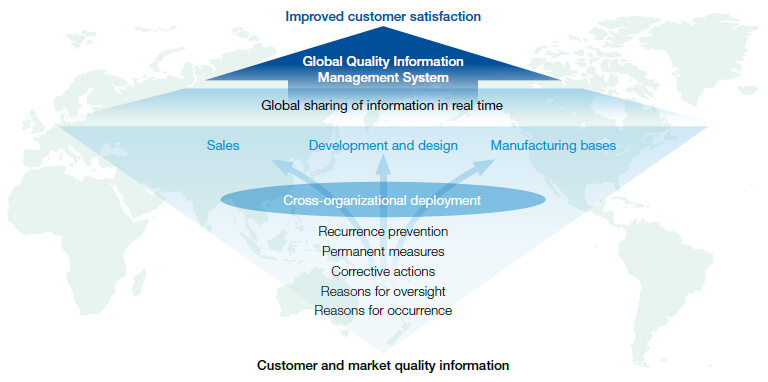
Alps Alpine’s Global Quality Information Management System is a means of containing (preventing) defects and involves global sharing of quality information to allow swift improvements across the organization. The system allows us to use quality information from customers and the market on a global scale to quickly diagnose problems and implement solutions. Measures taken and improvements made are also adopted as standard practice, thereby preventing recurrence and spotlighting areas of focus in the development of future product models.
Advanced EMC* Evaluation Technology
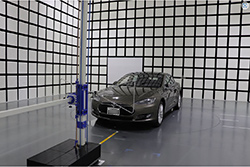
Our EMC Evaluation Center is used to assess the ability of our products to function in an electromagnetic environment and to assess whether electromagnetic radiation emitted from our products falls within the required levels.
Utilizing state-of-the-art facilities and the expertise and human resources we have built up in the field of RF product evaluation over many years, Alps Alpine has acquired ISO/IEC 17025 testing laboratory accreditation (A2LA) and customer certification, and has developed methods for evaluating products that incorporate new technology, while also contributing to greater dependability of products by quickly feeding the results of evaluations back into development departments. We realize an elevated level of electromagnetic compatibility (EMC) evaluation that is trusted both internally and externally.
In 2025, EMC testing infrastructure was strengthened with the completion of a new EMC test lab building inside the Iwaki R&D Center. Scheduled to be fully operational in March 2026, the building is expected to contribute to advanced levels of automobile safety and comfort.
* EMC (Electromagnetic Compatibility): The ability of electronic devices to operate normally without emitting electromagnetic interference or even if they are subjected to electromagnetic interference.
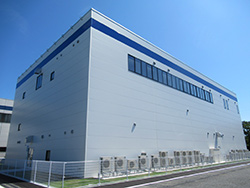
New EMC test lab building
Functional Safety
Functional Safety of Automotive Products
Safety requirements for products incorporated into vehicles are mounting due to the spread of technologies like driver assistance systems and automated driving systems. To ensure delivery to customers of safe, dependable products, Alps Alpine established commercialization processes and systems conforming to functional safety standard ISO 26262 (2nd edition, effective December 2018) and has already developed products compliant with the functional safety standard for automakers at home and abroad.
We pursue activities aiming to establish and foster a culture of safety so that employees involved with the development and production of automotive products put safety first in their decision-making and actions. Related activities are pursued in accordance with our functional safety guide.
Alps Alpine makes continual improvements to activities relating to the functional safety of products incorporated into vehicles. These improvements are achieved by regularly conducting comprehensive and reflective management reviews within the Board of Directors and by formulating and implementing annual action policies and priority measures.
Product Cybersecurity
Cybersecurity for Automotive Products
Ensuring automotive cybersecurity is now normal practice. Before introduction to the market, new vehicles must comply with UN Regulation No. 155 and the cybersecurity regulations of each country. Cybersecurity is expected to grow in importance with the advance of software-defined vehicles (SDVs)*.
To deliver to customers products that are secure, Alps Alpine maintains compliance with ISO/SAE 21434, a cybersecurity standard introduced in August 2021 for products in road vehicles. We also organize and operate a product security incident response team, Alps Alpine-PSIRT, to address any vulnerabilities found in our products.
Alps Alpine places importance on automotive cybersecurity during the product creation and manufacturing process, with all employees involved during the life cycles of automotive products understanding their roles and responsibilities in line with our basic policy on cybersecurity. We also participate in activities of industry groups, such as J-Auto-ISAC, helping to enhance cybersecurity capabilities across the industry.
As with functional safety, activities relating to the cybersecurity of automotive products regularly undergo a management review within the Board of Directors, tying in with ongoing improvement efforts.
Initiatives relating to cybersecurity management systems (CSMS) are undertaken in line with the Information Security Basic Policy .
.
* A software-defined vehicle (SDV) is a next-generation vehicle able to deliver new value through continual function updates.
Cybersecurity Management System Organizational Audits
Alps Alpine annually conducts cybersecurity management system (CSMS) organizational audits to determine the execution environment, implementation status, and capabilities for cybersecurity activities across the organization. In March 2023, Alps Alpine underwent an external audit. All relevant bases worldwide were certified to be compliant with the ISO/SAE 21434 management system standard.
Cybersecurity Education and Capability Management
Alps Alpine commenced cybersecurity education and capability management in fiscal 2021 as a way of entrenching and enhancing readiness relating to product cybersecurity within the company’s organization. After determining the education required according to the capability level, basic education and specialized training for individual activity processes are carried out across the global organization.