Conservation of Natural Capital
Basic Policy
Our business activities are dependent on natural capital and also have some degree of impact on natural capital. For example, we utilize resources as materials, use and release water during manufacturing, and release emissions into the air. Alps Alpine set out to determine the level of dependence and the degree of impact, conducting a comprehensive assessment of our business footprint with the help of Ecological Footprint Japan*1.
From a corporate sustainability perspective, we see preserving and restoring the integrity of natural capital as essential. Alps Alpine needs to make ongoing use of natural capital within the limits of natural regeneration and we have made it our goal to realize corporate activities that are in harmony with nature’s regenerative capacity by fiscal 2050.
*1 Ecological Footprint Japan: https://ecofoot.jp/
Calculating Our Business Footprint
We measured the business footprint of all our business activities in Japan to identify which functions of natural capital our business activities depend on, and to assess the environmental impact of those activities, at each stage of the product life cycle.
- What Is a Business Footprint?
- Until now, environmental action by corporations has typically entailed understanding the environmental impact – emissions and usage – in a linear way and undertaking to reduce the impact at each stage. However, a true assessment of sustainability requires looking at business activities in their relationship with nature. Nature is not simply a sink that absorbs an environmental load. It possesses the regenerative capacity to provide, purify, decompose and absorb. An ecological footprint is an indicator assessing human activity according to how well it achieves balance with nature’s regenerative capacity. An ecological footprint makes it possible to structurally visualize how a corporation depends on natural capital and how much stress (impact) it is applying to natural capital. Applied to a corporation’s business activities, it is a “business footprint.”
Calculation Method
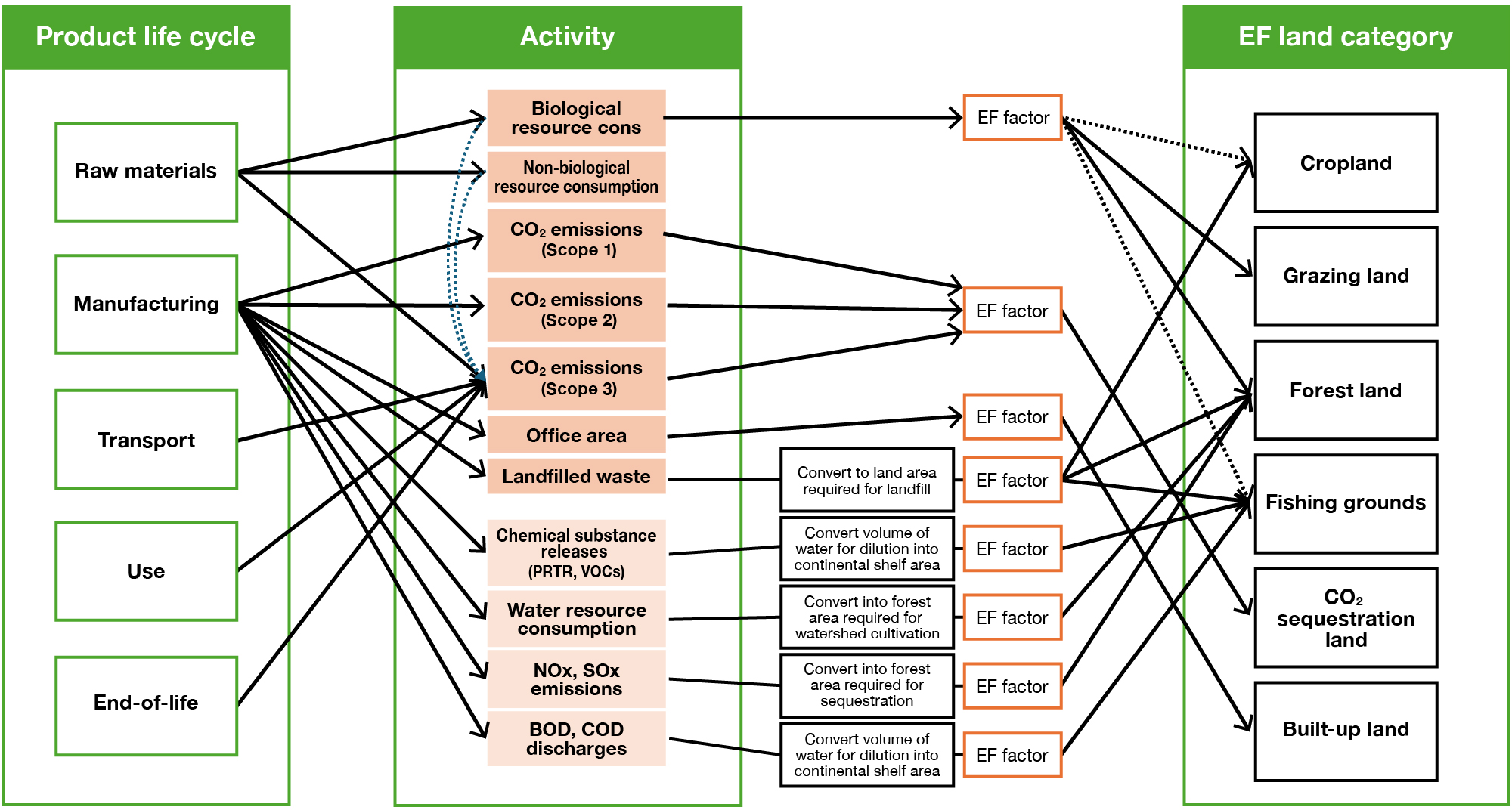
As an assessment metric, an ecological footprint evaluates the consumption of natural resources by human activity, expressed in terms of land area. For Alps Alpine’s business footprint, we convert our business activities (consumption) at each stage of the product life cycle into land area, divided into six land categories. Because the biological productivity of each land use differs for each country or region, we use EF*2 factors to measure the global average biological productivity.
*2 Ecological footprint
Calculation Approach
To calculate our business footprint, we used a combination of the following two approaches.
1) Basic Ecological Footprint (Standard)
Using globally established ecological footprint standards, we assessed our footprint in terms of the following four areas, which have a clear corresponding relationship with biocapacity (the regenerative capacity of land).
- Biological resource consumption (raw materials)
- Carbon dioxide emissions
- Land use
- Waste
2) Expanded Ecological Footprint
Some activities cannot be directly assessed using the standard method because they do not have globally defined EF factors. We therefore developed conversion logic based on scientific knowledge and reference materials and indirectly calculated the ecological footprint in terms of the stress applied to ecosystem services*3 performed by nature, such as purification, decomposition and absorption. The areas covered are as follows.
*3 Ecosystem services are the benefits to humans of natural ecosystems.
- Chemical substance releases (PRTR substances, VOCs)
- Organic pollutants (BOD, COD)
- Air pollutants (e.g. NOx, SOx)
- Water use
Calculation Results and Analysis
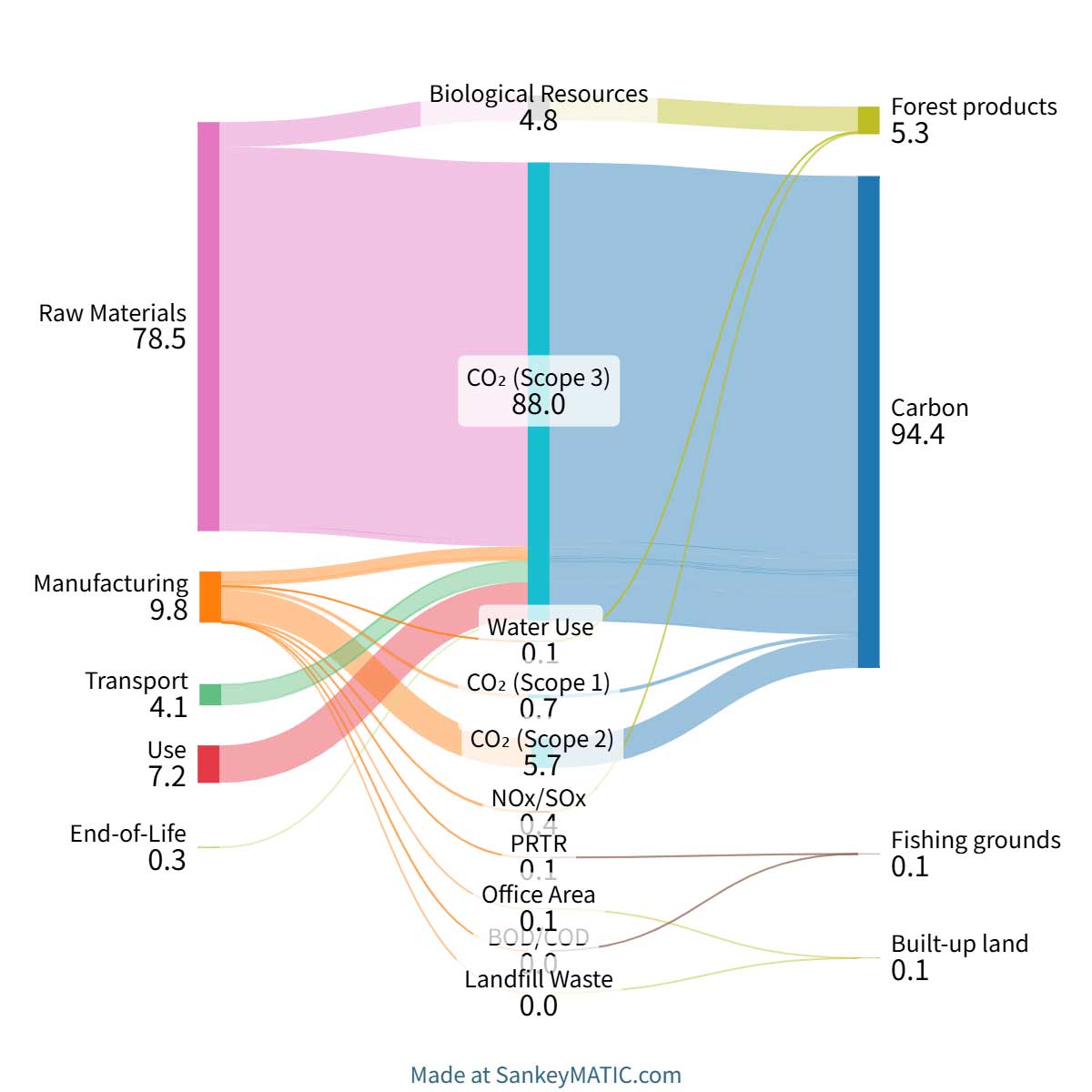
The Sankey diagram below visualizes the impact, in terms of land category, that different activities during the product life cycle have on natural capital. The diagram shows activities such as raw material procurement, manufacturing, and use, and illustrates how the corresponding environmental impacts (e.g. CO2 emissions, biological resource consumption) translate into ecological footprint land categories.
The business ecological footprint of Alps Alpine’s business activities in Japan in fiscal 2023 was approximately 376,000 global hectares. Dependence on land for sequestering carbon dioxide accounted for 94% of the total. A large portion of the footprint showed a high reliance on ecosystem services of natural areas like forests that serve to control the climate.
In terms of the separate life cycles, raw material procurement accounted for around 79% of the entire ecological footprint, revealing that the environmental impact was concentrated in upstream stages.
Sankey diagram (unit: %)
The main feature of the ecological footprint is that it allows us to see environmental impacts in terms of the relationship with nature’s regenerative capacity. For example, CO2 emissions only tell us how much is emitted, whereas an ecological footprint provides an additional standpoint – the area of forest or soil required to absorb CO2. By visualizing this make-up, it is possible to visualize which activities are reliant on which natural capital and to what degree.
Another example is the strategic use of bioethanol as a substitute for petroleum to reduce CO2 emissions. Even if emissions are reduced, the strategy substantially increases cropland use. An ecological footprint makes it possible to see the transfer of burden, therefore making it an effective tool for a company aiming for zero environmental impact, like Alps Alpine.
We are now looking to expand calculation to encompass the global operation and build a framework for ascertaining the environmental impact of our business activities over time.
Biodiversity
The Kunming-Montreal Global Biodiversity Framework was adopted at the 15th meeting of the Conference of the Parties to the Convention on Biological Diversity (COP 15) in December 2022. The Framework’s mission to 2030 is to take urgent action to halt and reverse biodiversity loss and put nature on a path to recovery. There are 23 defined global targets.
Alps Alpine will continue the environmental conservation activities we have pursued so far and endeavor to evaluate and disclose impacts of our business activities on nature through frameworks such as the Taskforce on Nature-related Financial Disclosures (TNFD).
Biodiversity Conservation Action Policy
Help conserve threatened species and their habitats in areas where we operate through participation in local biodiversity conservation activities
IBAT Analysis
We used biodiversity assessment tool IBAT to analyze the situation of threatened species and conservation areas around our global production bases with reference to information for those locations.
Assessment of Threatened Species Around Global Production Bases
| Category | North America | Europe | Southeast Asia | East Asia (excl. Japan) |
Japan |
|---|---|---|---|---|---|
| No. of threatened species (CR,EN,VU) |
26 | 258 | 620 | 772 | 483 |
| No. of near threatened species (NT) |
26 | 159 | 264 | 268 | 334 |
| Others (LC,DD) |
882 | 737 | 1715 | 5081 | 7584 |
| No. of protected areas | 12 | 736 | 49 | 163 | 655 |
| No. of Key Biodiversity Areas | 0 | 14 | 5 | 17 | 35 |
- IUCN Status
-
CR: Critically endangeredEN: EndangeredVU: VulnerableNT: Near threatenedLC: Least concernDD: Data deficient
30by30 Alliance for Biodiversity
Alps Alpine joined the 30by30 Alliance for Biodiversity in July 2024.
The “30by30” target of the Alliance means efficient conservation of at least 30% of land and sea areas as healthy ecosystems by 2030 with aims to halt and reverse biodiversity loss (become “nature positive”) by 2030.
The 30by30 Alliance for Biodiversity was established to pursue the 30by30 target. Its purpose is to expand national parks, to register and promote the conservation of land protected by corporations, local governments and NPOs as “other effective area-based conservation measures,” or OECMs, and to actively disseminate information about those activities.
Alps Alpine agrees with these ambitions and carries out its own independent initiatives to help achieve the “nature positive” goal.

30by30 Alliance: https://policies.env.go.jp/nature/biodiversity/30by30alliance/documents/3030emap.pdf