Pollution Prevention & Chemical Substance Management
Basic Policy
The increasing gravity of environmental challenges, such as climate change action, resource circulation, and biodiversity conservation makes proper management of chemical substances a prerequisite for sustainable business activity. In particular, the environmental and health impacts of chemical substances and compliance with regulatory tightening worldwide are key themes that directly affect a corporation’s trustworthiness. Alps Alpine acknowledges this, identifying “strengthening chemical substance management to help reduce environmental impact” as a new material issue, and aims to be a company trusted by society by working with stakeholders to minimize environmental impact through better management.
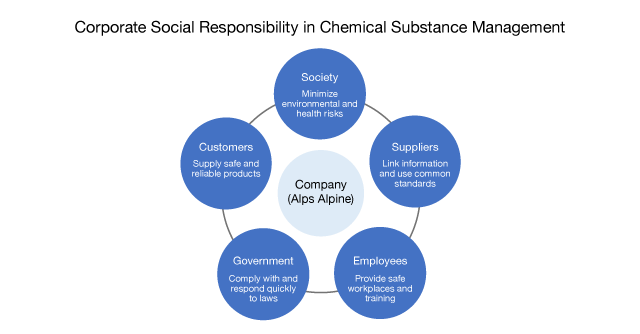
Management of Chemical Substances Contained in Products
In regard to the use and handling of chemical substances, Alps Alpine places top priority on the end user health and preservation of the environment. In managing chemical substances contained in products, we make efforts to comply with stringent standards and regulations, thereby minimizing adverse effects on the environment and potential risks to human health.
We also stay up to date with the latest laws and regulations, such as the RoHS Directive and REACH Regulation, and industry standards, reflecting them in our Green Procurement Standards as required. The Green Procurement Standards are a set of standards for managing chemical substances contained in our products. Steps are taken at each stage – parts and material procurement, production, and shipment – as follows.
| Parts/material selection and procurement |
|
|---|

| Production |
|
|---|
| Shipment |
|
|---|

Pollution Prevention
Alps Alpine views reducing the impact of business activities on the air, soil, and rivers and other water resources and environments as a foundation for coexistence with local communities and sustainable growth. For that reason, we position pollution prevention as a key theme and make efforts to strengthen controls helping to reduce emissions of volatile organic compounds (VOCs), prevent soil and groundwater contamination, and prevent environmental accidents.
Reducing Volatile Organic Compound (VOC) Emissions
Alps Alpine has continually sought to reduce VOC emissions in line with revisions to the Air Pollution Control Act that took effect in 2006. Emissions were identified and action was taken at each business site while achieving compliance with the law, including through notification of specified units and stronger management of those facilities. In fiscal 2024, the amount of VOCs handled within the manufacturing process increased slightly but was kept roughly level with the previous fiscal year.
Preventing Soil and Groundwater Pollution
Alps Alpine has implemented a wide range of measures to minimize contamination of soil and groundwater. For example, we have replaced underground pipelines with aboveground pipes, constructed containment dikes around supply inlets of heavy fuel storage tanks, and installed spill sensors. These measures enable early discovery and a quick response in the event of an actualized risk.
At bases in Japan, we have installed pump and purification systems at the edge of our premises where groundwater flows downstream as a measure to prevent groundwater that exceeds thresholds from escaping off site.
Preventing Environmental Accidents Resulting from Use of Chemical Substances
We view proper management of environmental risks associated with chemical substances and efforts to prevent accidents as not only a legal requirement but also part of our social obligation to keep the community safe and protect the environment.
At each base, patrols are undertaken to ascertain chemical substance usage, emergency response plans are drawn up to prepare for unforeseen events, and drills are regularly implemented in line with those plans.
Environmental risk maps are also drawn up for each plant and updated on a regular basis. These maps are drawings showing, for example, where chemical substances and waste are stored and handled. They visualize areas where accident risk is high, helping to lower the risk to the environment.
| FY2022 | FY2023 | FY2024 | |
|---|---|---|---|
| Number of accidents involving regulated substances contained in products (consolidated) |
0 | 0 | 0 |
| Number of serious accidents caused by chemical substances at business sites (consolidated) |
0 | 0 | 0 |