Environmental Strategy
Basic Policy
Alps Alpine’s corporate philosophy, “Alps Alpine innovates value for humans and society on a brighter planet,” is our mission of aiming to contribute to a sustainable society in which people’s lives and the global environment can be sustained into the future.
Our business activities are affected by increasingly serious environmental issues, such as climate change caused by global warming, depletion of resources, and biodiversity loss. Alps Alpine takes these issues seriously. As a manufacturer seeking harmony with the environment, we will contribute to the realization of a sustainable society by achieving our goals of carbon neutrality by 2050 and zero environmental impact.
Materiality and Mid-Term Targets
Alps Alpine has set long-term targets for 2050 and medium-term targets for 2030 in the environmental field. We reanalyzed the risks and opportunities to achieve these targets and, based on the results, we identified three material issues for the Mid-Term Business Plan 2027. By proactively advancing initiatives to address these material issues, we aim to achieve our targets and enhance corporate value.
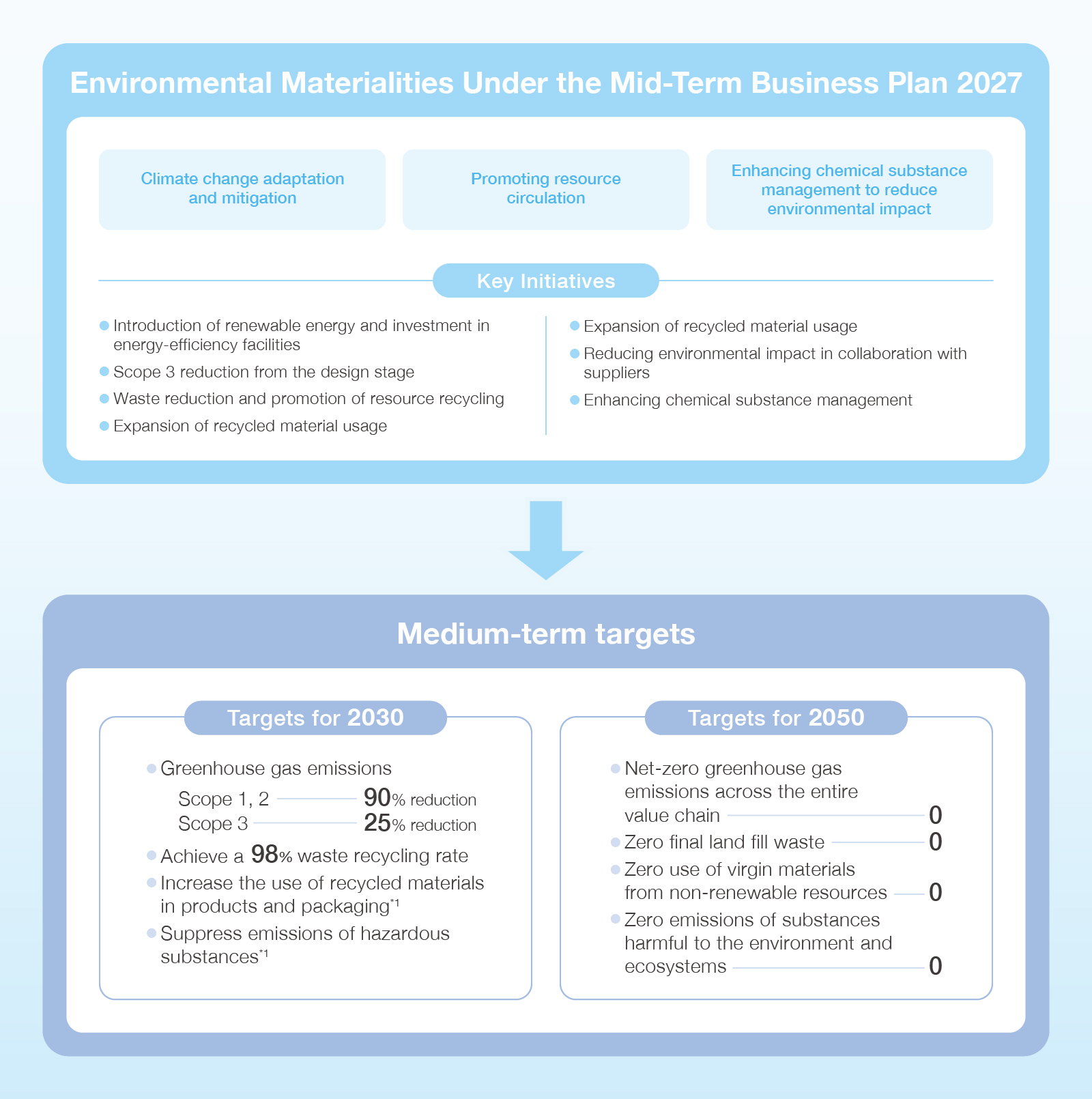
*1 Quantitative targets are currently under review.
Environmental Policy
Based on corporate philosophy, we will contribute to the realization of a sustainable society by implementing initiatives for “climate change adaptation and mitigation“, "promoting resource recycling“, "strengthening chemical substance management to reduce environmental impact“.
- Promote climate change adaptation and mitigation and reduce greenhouse gas emissions related to business activities and products
- Promote the effective use and circulation of resources
- Reduce the negative impact of chemical substances on people and the global environment
Environmental Management
Launch of a Companywide Environmental Project
To realize our long-term targets, it was vital that we put in place a framework for ongoing and strategic companywide and cross-functional implementation of environmental efforts that went beyond singular measures and initiatives advanced by individual departments, and which centered on medium-term targets backcasted from fiscal 2050 targets. Accordingly, an environmental project dedicated to companywide, cross-functional advancement of initiatives relating to climate change and resource circulation was formed in January 2026.
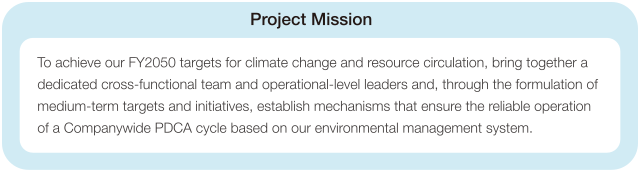
Project Structure
The project is being advanced through collaboration between a dedicated cross-functional team and each division. Deliverables from each milestone are reviewed and approved by the Sustainability Committee, which meets quarterly and is attended by all vice presidents.
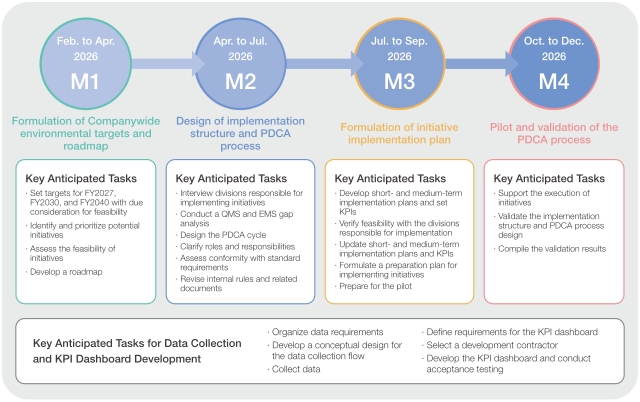
Project Activity Plan
The project will run for one year, from January through December 2026, with milestones set at three-month intervals. In M1, we will formulate Companywide environmental targets and a medium-term roadmap. In M2, we will design the implementation structure and PDCA process. In M3, we will formulate an initiative implementation plan for the following fiscal year and the next three-year period. In M4, we will pilot and validate the PDCA process within a small organization. We will also establish an environmental data collection framework and develop a KPI dashboard.
Environmental Management System Operation
All Alps Alpine production bases have established environmental management systems (EMS) and have acquired ISO 14001 EMS certification.
With environmental issues such as climate change and resource circulation growing in significance in recent years, Alps Alpine is strengthening its frameworks for achieving companywide environmental targets. The environmental project is undertaking to set companywide targets, propose priority measures and establish implementation frameworks. Following completion of the project, its responsibilities will be taken up by a unit charged with companywide promotion. This successor organization will monitor the progress of measures and verify their effects within the EMS infrastructure, thereby implementing a companywide PDCA cycle that leads to steady attainment of environmental targets.
Metrics and Targets
Mid-Term Management Plan 2027 metrics and targets and past performance are as follows.
| Scope | FY2023 Results |
FY2024 Results |
FY2025 Results |
Mid-Term Management Plan 2027 FY2027 Target |
||
|---|---|---|---|---|---|---|
| Scope 1 and 2 GHG emissions (compared with FY2021) |
Consolidated | ▲47% | ▲61% | ▲65% | ▲70% | |
| Scope 3 GHG emissions (compared with FY2021) |
Consolidated | +59% | +68% | +33% | FY2030 Target ▲25% |
|
| Renewable energy use rate | Consolidated | 63% | 72% | 77% | 85% | |
| Waste recycling rate* | Consolidated | ー | 95% | 96% | 97% | |
| Number of serious incidents involving regulated substances in products | Consolidated | ー | 0 cases | 1 case | 0 cases | |
| Number of serious incidents caused by chemical substances at business sites | Consolidated | ー | 0 cases | 0 cases | 0 cases |
*Ratio of waste not sent to landfill